


Publications

Achieving SDG indicator 5.a.2 in the Western Balkans and beyond Partnerships for gender equality in land ownership and control
01/05/2022
FAO and the Deutsche Gesellschaft für Internationale Zusammenarbeit (GIZ) GmbH have been providing support to the Western Balkans region to promote progress on gender equality, with a focus on measuring the proportion of countries where the legal framework guarantees women’s equal rights to land ownership and/or control. 20 pp.

The State of the World’s Forests 2022
01/05/2022
Against the backdrop of the Glasgow Leaders’ Declaration on Forests and Land Use and the pledge of 140 countries to eliminate forest loss by 2030 and to support restoration and sustainable forestry, the 2022 edition of The State of the World’s Forests (SOFO) explores the potential of three forest pathways for achieving green recovery and tackling multidimensional planetary crises, including climate change and biodiversity loss. 166 p.

Technical Guide on the Integration of the VGGT into the Implementation of the United Nations Convention to Combat Desertification and Land Degradation Neutrality
01/05/2022
This technical guide addresses the integration of the Voluntary Guidelines on the Responsible Governance of Tenure of Land, Fisheries, and Forests in the Context of National Food Security (VGGT) within the implementation of the UNCCD and Land Degradation Neutrality (LDN), thus opening a new chapter in ongoing efforts to combat desertification, land degradation, and drought. 100 p.

Women and men in small-scale fisheries and aquaculture in Asia - Barriers, constraints and opportunities towards equality and secure livelihoods
23/04/2022
Fisheries and aquaculture contribute to food security and livelihoods of millions of people in Asia. Both women and men are engaged in fisheries and aquaculture. In the past ten years, many actors have worked on raising awareness on women’s contribution as well as promoting gender equality in fisheries and aquaculture. This study aims to consolidate the efforts to date to provide recommendations for action and future studies. 186 pp.

FAO’s work on gender in forestry
23/04/2022
This brochure shows how the different initiatives, programmes and projects of the FAO Forestry Division mainstream gender into their implementing activities and contribute to strengthening gender equality and women’s empowerment. 12 pp.

Gender-related impacts of the Ukraine Conflict
02/04/2022
Entry points for gender-responsive and inclusive interventions for Ukraine crisis. 5 p.

FAO Europe and Central Asia Gender Newsletter, March 2022 - Issue #6
31/03/2022
Each issue of FAO Europe and Central Asia Gender Newsletter explores and discusses women’s and men’s experiences in agriculture and food security in the region familiarizes the reader with relevant FAO activities and initiatives. 6 pp.
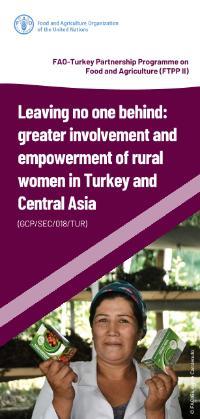
Leaving no one behind: greater involvement and empowerment of rural women in Turkey and Central Asia (GCP/SEC/018/TUR)
26/03/2022
This publication is a short summary of the project that will help grass-roots rural women in Tajikistan, Turkey and Uzbekistan, gain knowledge and skills to improve their economic status, start businesses and cooperatives, while empowering them to become agents of change in their communities. The project will also contribute to the creation of an enabling environment for rural women’s economic empowerment. 6 pp.