


Agriculture provides direct livelihoods for 2.5 billion people globally and feeds the entire planet. By 2050, as populations grow and diets change, the sector must produce 49 percent more food than in 2012. Yet climate change, biodiversity loss, land degradation, water scarcity, pollution and many other challenges are hampering efforts to feed the planet.
The 2030 Agenda for Sustainable Development calls upon everyone to address these issues. Sound and timely data is key to inform and guide decision makers as we take meaningful and effective action. Geospatial data (simply defined as information with a geographical component), methods and tools are essential in providing this key data for agriculture.
The Food and Agriculture Organization of the United Nations (FAO) has more than 50 years of experience in the development and use of geospatial data, methods and tools, which are applied to local, national, regional, and global sustainable development planning and implementation. FAO helps countries implement appropriate geospatial solutions, assisting their efforts to create sustainable agrifood systems, organizing and delivering this work to Member Nations through projects and programmes carried out at FAO headquarters and regional, subregional and national offices. In this way, FAO ensures the adoption and implementation of best practices and standards.
Focus areas


Main data and tools



Recent publications


Humanitarian mine action: An investment in agricultural recovery for food security in Ukraine in 2026
03/08/2026
Explosive ordnance continues to constrain agricultural recovery in Ukraine by preventing safe access to farmland, delaying seasonal operations and reducing the area that can be cultivated, making humanitarian mine action a precondition for food security rather than a safety intervention alone.

Historical assessment of agricultural drought impact in the Syrian Arab Republic (2021–2025)
31/07/2026
The Syrian Arab Republic's agricultural sector is highly vulnerable to drought due to its dependence on rainfall, limited water resources and increasing climate variability. Recurrent drought events have severely affected crop production, rangelands, livestock systems, and rural livelihoods, threatening food security across the country.
Events

Celebrating the International Day of Tea: Monitoring tea plantations with remote sensing
21/05/2026
FAO is collaborating with the Chinese Academy of Sciences – Centre for Big Earth Data Science (CAS–CBAS) for knowledge- and data-sharing...

Roma (Italy)
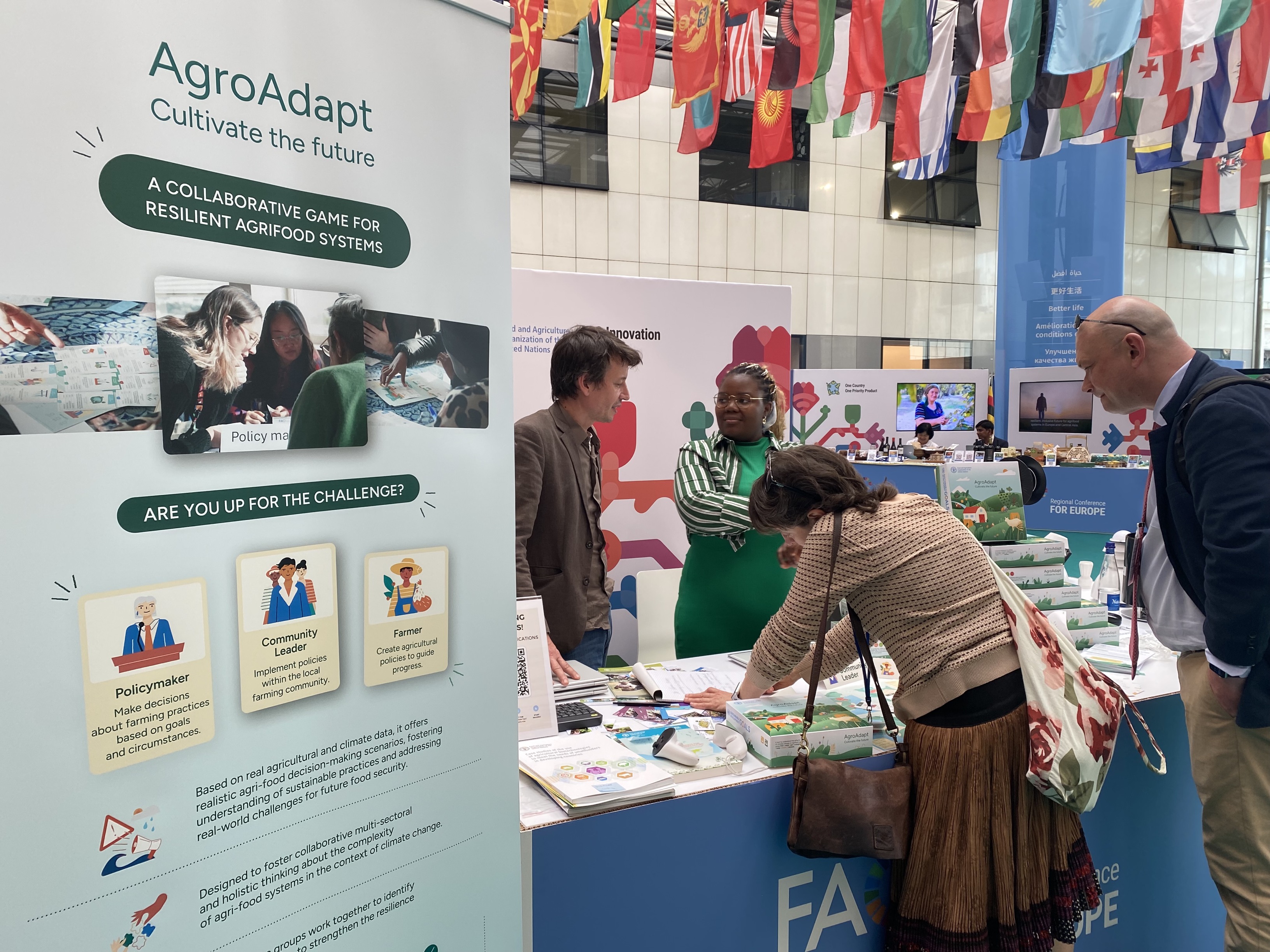
Discover AgroAdapt at the SIF Booth
17/10/2025
The Geospatial Unit will present AgroAdapt at the Science and Innovation Forum booth in the Atrium (Friday, 17 October 2025 from 9.00 to 11.00 CEST)....

Roma (Italy)
AgroAdapt: Exposing Youth to the Impact of Climate Change in Agriculture through Gamification
15/10/2025
Join the Youth side event dedicated to AgroAdapt: Cultivate the Future, an interactive simulation game on climate change and agriculture,...
Roma (Italy)
Play AgroAdapt at the From Seeds to Food Exhibition
12/10/2025
Join the Geospatial Unit to play AgroAdapt during the

Roma (Italy)
Geospatial at the first Global Exhibition “From Seeds to Foods”
10/10/2025 - 13/10/2025
Join the Geospatial team at the Global Exhibition “From Seeds to Foods”, Parco...
Related links
- FAO Land and Water
- Land Resources Databases/Information Systems
- Aquamaps
- WaPOR
- GLOSIS
- Earth Observation
- National Forest Monitoring Systems
- Fisheries and Resources
- Food and Agriculture Microdata Catalogue (FAM)
- Global Livestock Environmental Assessment Model (GLEAM)
- United Nations Office for Outer Space Affairs (UNOOSA)
- The International Charter Space and Major Disasters