


Emergency and resilience

Risks and disaster management
Natural and human–induced hazards – including floods, droughts, wildfires, earthquakes, and conflicts – pose significant threats to global agriculture, food security and rural livelihoods. Climate change is intensifying these risks, increasing the frequency and severity of extreme weather events.
Disasters can cause prolonged agricultural declines, such as through droughts, or due to sudden devastation, such as floods and wildfires. In crises–affected areas, the impact extends beyond crop and livestock losses, as damaged infrastructure, disrupted supply chains, and restricted farmland access exacerbate food insecurity, economic instability and humanitarian challenges.
The Food and Agriculture Organization of the United Nations (FAO)’s Geospatial Unit leverages high–resolution satellite imagery, artificial intelligence (AI), and cloud–based data processing to strengthen disaster preparedness and recovery efforts. Remote sensing enhances early warning systems and impact assessments, enabling data–driven decision–making and guiding effective interventions. In conflict zones, geospatial technologies are essential for assessing impacts and supporting emergency response by enabling timely actions and accurate damage assessments, even in remote or inaccessible areas.
In collaboration with other FAO units like the Office of Emergencies and Resilience (OER) and other United Nations (UN) agencies like the United Nations Satellite Centre (UNOSAT), FAO’s Geospatial Unit integrates remote sensing, agricultural statistics, and socioeconomic indicators to analyse disaster and crisis impacts.
Beyond emergency response, FAO supports countries in developing disaster risk management (DRM) plans that incorporate risk mapping, vulnerability assessments, and yield forecasting. These plans strengthen resilience by integrating prevention, mitigation and preparedness strategies.
Publications

Damage to greenhouses due to the conflict in the Gaza Strip as of 24 April 2026
24/06/2026
The assessment was built on a baseline greenhouse layer prepared by FAO and UNOSAT in 2023 and very high resolution satellite imagery prior to the recent conflict escalation. Following the ceasefire on 10 October 2025, the baseline was updated in April 2026 and conducted an assessment of the area and number of greenhouses in the Gaza Strip.

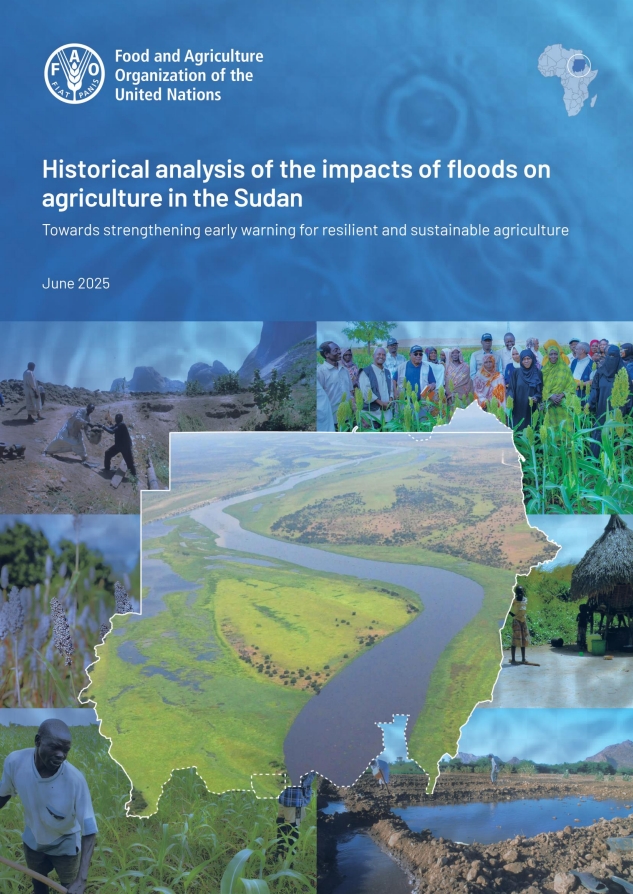
Historical analysis of the impacts of floods on agriculture in the Sudan
30/06/2025
The Sudan's agricultural sector contributes a third of the country’s gross domestic product (GDP) and supports two-thirds of the population, but faces significant challenges due to heavy floods and other extreme weather events. However, the Sudan lacks an effective system for monitoring flooded farmlands, hindering disaster preparedness and response.
News
_thumb.tmb-th600x400.jpg?sfvrsn=dfcd8188_2 "thumbnail_banner (1)")
Launch of the publication “Geospatial applications in emergency impact assessment”
14/05/2024
"Geospatial Applications in Emergency Impact Assessment” highlights the increasing frequency and intensity of natural hazards and conflicts, and...

Leveraging Geospatial Technology to Bridge the Data Gap for Efficient Management of Agricultural Water
29/04/2024
The Food and Agriculture Organization of the United Nations (FAO) hosted a technical session "Leveraging Geospatial Technology to Bridge the Data Gap...

FAO Conducts Training in Bangui to Enhance Hydrological and Meteorological Emergency Management Using Space-Based Data
04/05/2023
In the Central African Republic, the Ministry of Agriculture, in collaboration with the World Bank, successfully concluded the first computerized spatial...

FAO provides technical support to build disaster resilience in Pakistan
19/03/2018
Under the ‘Building disaster resilience in Pakistan (BDRP)’ Programme, FAO’s Geospatial Unit has been supporting the implementation of Pakistan’s National...