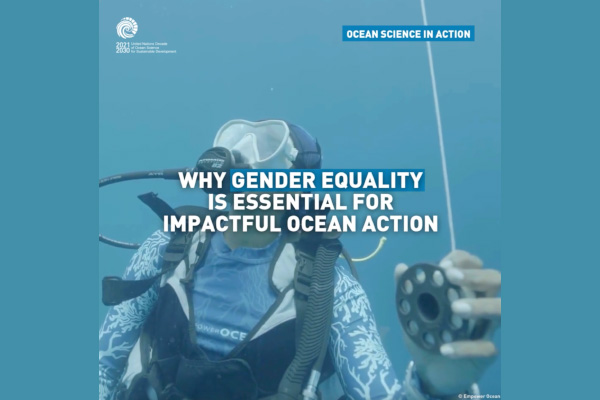
In collaboration with regional organizations and 32 countries across Africa and the Bay of Bengal, the EAF-Nansen Programme is improving fisheries management in line with the ecosystem approach to fisheries (EAF), strengthening the capacities of fisheries institutions and generating scientific knowledge on marine resources and ecosystems.
Building on lessons learned from previous phases, the current Programme contributes to improved food and nutrition security. From 2024-2028, it will focus on bridging science and fisheries management for strengthened ocean governance, while addressing challenges like pollution and climate change.
It contributes to FAO's vision for FAO's vision for the Blue Transformation of aquatic food systems for better production, better nutrition, a better environment, and a better life for all.
EAF-Nansen Programme and the UN Decade of Ocean Science
 In 2021, the Programme became part of the United Nations Decade of Ocean Science for Sustainable Development (2021-2030) – a UN-wide initiative that provides a common framework for international dialogue and global action to ensure that ocean science can fully support nations to meet Sustainable Development Goals (SDGs) by 2030.
Being a UN Decade Action Programme, it actively contributes to six of the ten Ocean Decade Challenges, and is fully aligned with the mission to generate transformative ocean science solutions for the ocean, while fostering connections between people and the ocean [more].
Regional workshop on the EAF-Nansen Programme and planning meeting of the 2017 R/V Dr Fridtjof Nansen surveys in the Gulf of Guinea, Accra, Ghana 4–6 July 2017
05/11/2020
The main objectives of the workshop were to introduce partners to the components and expected outputs of the new EAF-Nansen Programme, and to identify priorities for the upcoming survey and in the programme, in general, for the countries of the Gulf of Guinea.
Available in
Regional workshop on the EAF-Nansen Programme and planning meeting of the 2017 R/V Dr Fridtjof Nansen Northwest Africa regional pelagic resources and ecosystem survey, Casablanca, Morocco 3–5 May 2017
04/11/2020
This is the report of a regional workshop organised under the EAF-Nansen Programme. The main objectives of the workshop were to determine regional priorities within the research themes of the EAF-Nansen Programme science plan, identify specific research that could be carried out collaboratively and to review objectives of the 2017 R/V Dr Fridtjof Nansen survey in Northwest Africa.
Available in

The EAF-Nansen Programme Capacity Development Strategy
03/11/2020
This strategy document was formulated to guide the EAF-Nansen Programme capacity development activities. The current phase of the Nansen Programme aims to strengthen capacity of countries and regional organizations for managing fisheries according to the ecosystem approach to fisheries (EAF) through an integrated approach, considering all three levels of interlinked capacity: enabling environment, institutional and individual.

The EAF-Nansen Programme Gender Strategy
22/09/2020
This is a strategy document of the EAF-Nansen Programme, formulated to guide the Programme’s activities on gender equality aspect. Mainstreaming gender and striving for gender equality in fisheries will support the EAF-Nansen Programme in achieving its intended impact: “sustainable fisheries improve food and nutrition security for people in partner countries.” Thus, much like FAO, the EAF-Nansen Programme promotes gender equality in all its areas of work.

The EAF-Nansen Programme Communication Strategy
22/09/2020
This is a strategy document of the EAF-Nansen Programme, formulated to guide the Programme’s communication activities. It was prepared with the aim of achieving the outcome, purpose and goals defined in the Programme Document, while contributing to the accomplishment of FAO’s strategic objectives.

Survey results on the fishery resources and marine ecosystems of Myanmar
08/05/2020
This policy brief summarises the main results of three marine fishery/ecosystem surveys conducted in Myanmar waters in 2013, 2015 and 2018, with the use of the research vessel Dr Fridtjof Nansen. It also presents an overview of the main findings from previous surveys, by contrasting current and past findings. The brief provides useful key observations and recommendations.
Available in

Summary Report - FAO Working Group on the Assessment of Small Pelagic Fish off Northwest Africa 2019
01/01/2020
This summary provides the preliminary results, not yet validated by the Scientific Sub-Committee (SSC) of the Fishery Committee for the Eastern Central Atlantic (CECAF), of the nineteenth meeting of the FAO Working Group on the Assessment of Small Pelagic Fish off Northwest Africa held in Casablanca, Morocco, 8-13 July 2019.

CECAF-PESCAO Project Improved Fisheries Governance in West Africa Report of the Project Inception Workshop – Akosombo, Ghana, 24–26 April 2019
01/01/2020
The inception meeting of the PESCA-CECAF project was held at the Volta Hotel in Akosombo, Ghana from 24 to 26 April 2018.

EAF-Nansen Programme Yearly Summary 2018
03/12/2019
This is an annual summary for 2018, summarizing activities carried out during the year. The document provides an overiew of the work, including research surveys on board the research vessel (R/V) Dr Fridtjof Nansen. We continued with the development of research work under the programme in support of the ecosystem approach to fisheries (EAF).
Available in

The EAF-Nansen Programme Science plan - Supporting the Application of the Ecosystem Approach to Fisheries Management considering Climate and Pollution Impacts
18/04/2019
The Science Plan addresses the overall principles and main thematic areas for the research of the EAF-Nansen Programme, including the use of the research vessel (R/V) Dr Fridtjof Nansen as a key tool for field work. Since 1975, the Nansen Programme has supported developing countries in fisheries research and management in their efforts to enhance food security.

Fishery and oceanographic research vessel the R/V Dr Fridtjof Nansen
18/04/2019
The research vessel (R/V) Dr Fridtjof Nansen is a state of the art research vessel that serves the countries partners to the EAF-Nansen Programme “Supporting the Application of the Ecosystem Approach to Fisheries management considering climate and pollution impacts” to generate knowledge on resources and ecosystems by use of the art gears and technologies, providing key information of complex and changing marine ecosystems to the benefit of partner countries.
Available in

Report of the Eighth Session of the Scientific Sub-Committee of the Fishery Committee for the Eastern Central Atlantic, Abidjan, Côte d’Ivoire, 23–26 October 2018 / Rapport de la huitième session du Sous-Comité scientifique du Comité des pêches pour l’Atlantique Centre-Est, Abidjan, Côte d’Ivoire, 23–26 octobre 2018
01/01/2019
This document is the final report of the eighth session of the Scientific Sub-Committee of the Fishery Committee for the Eastern Central Atlantic (CECAF), which was held in Abidjan, Côte d’Ivoire from 23 to 26 October 2018. The SSC was immediately preceeded by a one-day meeting, on 22 October, on the EAF-Nansen Programme and upcoming survey related activities in the CECAF region.

Report of the FAO Working Group on the Assessment of Small Pelagic Fish off Northwest Africa. Banjul, the Gambia, 26 June–1 July 2018. Rapport du Groupe de travail de la FAO sur l’évaluation des petits pélagiques au large de l’Afrique nord-occidentale. Banjul, Gambie, 26 juin–1 juillet 2018.
01/01/2019
The eighteenth meeting of the FAO Working Group on the Assessment of Small Pelagic Fish off Northwest Africa was held in Banjul, the Gambia, 26 June–1 July 2018.

FAO Tanzania Newsletter 2nd quarter 2018 - Issue#5
03/10/2018
The State-of-the-art marine research vessel Dr. Fridtjof Nansen concluded its research on fishery resources and ecosystem on Tanzania’s Indian Ocean waters that was conducted from April 4 to 19 this year.

Supporting the Application of the Ecosystem Approach to Fisheries Management considering Climate Change and Pollution Impacts
13/07/2018
The Norway-funded Nansen Programme has supported developing countries in fisheries research and management for more than 40 years, evolving over time to address key drivers of importance for fisheries management. This makes it one of the longest runn...

The RV Dr Fridtjof Nansen in the Western Indian Ocean: Voyages of marine research and capacity development
01/03/2017
The research vessel Dr Fridtjof Nansen operates within the EAF-Nansen project of FAO, and carries out fish resources and ecosystems surveys in the maritime waters of developing countries, particularly in Africa. The surveys are facilitated by FAO and the vessel flies a UN flag.

e-Approach
01/01/2017
The primary objective of EAF-Nansen project newsletter, e-APPROACH, is to raise public awareness and understanding of the EAF-Nansen project and on the importance of EAF as a contribution to global sustainable development mechanism to support sustainable use and management of marine ecosystems. Since 2009 the e-Approach is published four times per year and includes all the activities carried out in the framework of the EAF-Nansen project.

e-Approach: EAF-Nansen project Newsletter. No. 29/30, July/December 2016
01/01/2017
The primary objective of EAF-Nansen project newsletter, e-APPROACH, is to raise public awareness and understanding of the EAF-Nansen project and on the importance of EAF as a contribution to global sustainable development mechanism to support sustainable use and management of marine ecosystems. Since 2009 the e-Approach is published four times per year and includes all the activities carried out in the framework of the EAF-Nansen project.

A How-To guide on legislating for an Ecosystem Approach to Fisheries
08/08/2016
The basis of this How-to Guide is the identification of key minimum components for legislating for EAF (17 components that should be included in sector-specific legislation), the operationalization of those key components into concrete drafting steps, and the provision of relevant examples from national legislation, largely from Africa but also from other parts of the world.

Refocusing fisheries management in Africa: An Ecosystem Approach
20/07/2016
In 2006, the EAF-Nansen Project opened with a broad and ambitious objective: to enable African coastal countries to manage their fisheries in a way that would safeguard the health of marine ecosystems. The Norwegian government has made....