


Greening agriculture, water scarcity and climate action
The WEFE Nexus approach in fragile and dry landscapes
©FAO/Soliman Ahmed
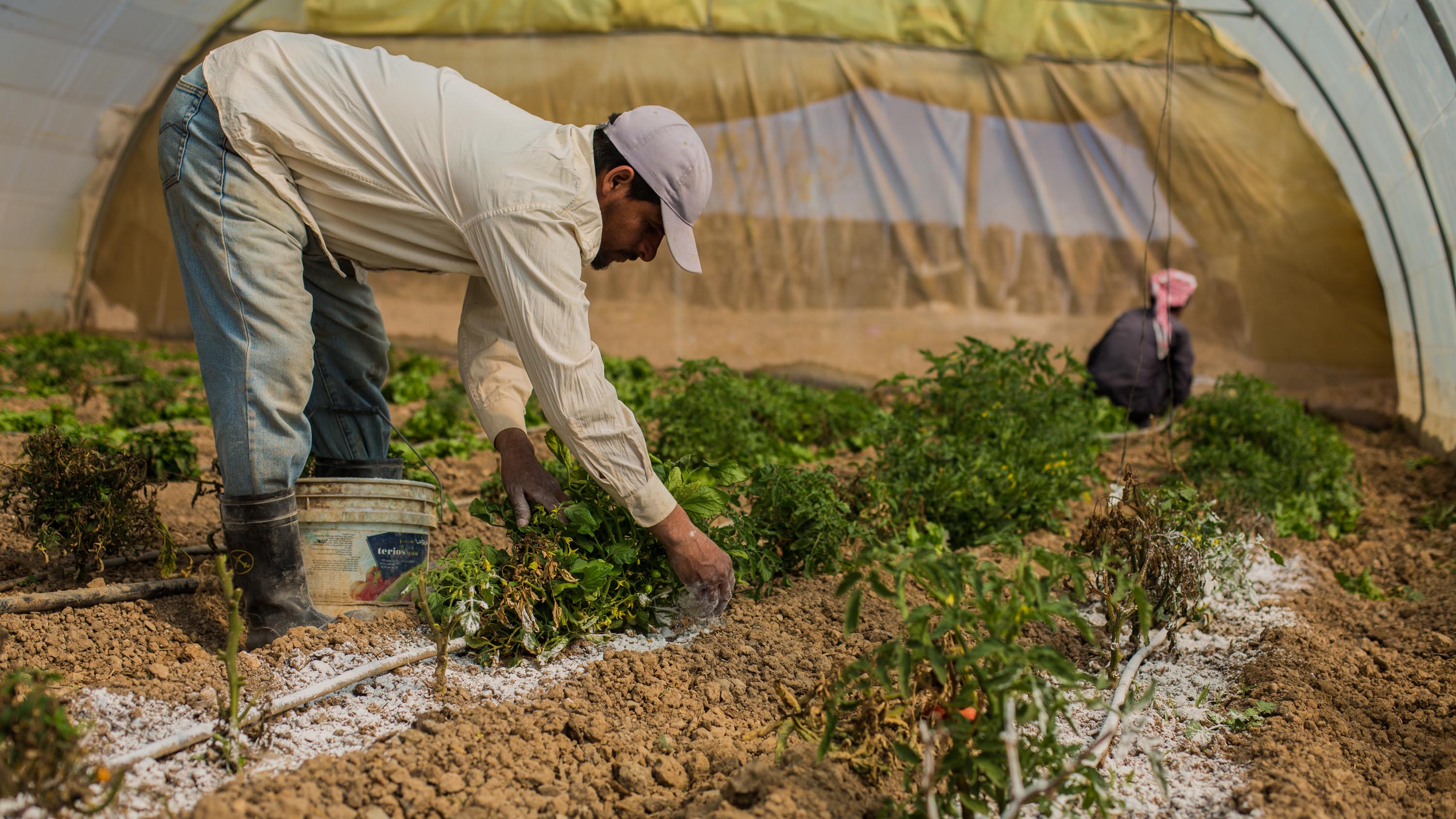
The Near East and North Africa (NENA) region is defined by vast drylands that shape its environment, economies, and cultures. Often wrongly perceived as barren, these landscapes host vibrant communities, unique biodiversity, and essential agricultural systems. Yet, they face mounting challenges. Climate change is intensifying droughts, floods, and heatwaves, accelerating land degradation and threatening food and water security. With scarcer and less predictable rainfall, soils degrading, and populations growing, the balance between people and nature is becoming increasingly fragile.
Water scarcity is the region’s defining challenge. NENA is the world’s most water-insecure and land-scarce region, with renewable water resources expected to fall by more than half by 2050. Nearly 70 percent of its land is desert or arid, and agriculture, the mainstay of many livelihoods, consumes around 85 percent of available freshwater. Climate change is expected to further reduce renewable water resources by as much as 20 percent by 2050 in arid and semi-arid regions, and over 60 percent of water resources flow from outside national borders, leaving countries heavily dependent on shared and increasingly stressed supplies. With just 0.14 hectares of arable land per person and 66 million people facing hunger, integrated and equitable water management is essential to sustain livelihoods and achieve the Sustainable Development Goals (SDGs).
From silos to systems: the WEFE Nexus approach
Achieving sustainable agrifood systems requires recognizing the interconnections between sectors. The Water–Energy–Food–Ecosystems (WEFE) Nexus provides an integrated framework to enhance efficiency, sustainability, and equity in managing natural resources. By adopting this approach, decision-makers can optimize resource use, reduce trade-offs, and create synergies that strengthen resilience and long-term sustainability.
The Nexus emphasizes coordinated, cross-sector planning to effectively use limited resources. Integrating restoration and development through this lens builds resilience, especially in countries without land degradation targets. For example, low-cost energy for groundwater pumping can boost agricultural productivity but may deplete aquifers and degrade water quality without coherent policies across energy, land use, and irrigation.
Water and energy systems are tightly linked: water drives energy generation through hydropower, cooling, and wastewater recovery, while energy is essential for pumping and treating water. Poor coordination can lead to pollution, higher energy demand, and ecosystem degradation. In agriculture, water sustains irrigation, livestock, and aquaculture, but inefficient use and runoff can contaminate groundwater, degrade soils, and harm biodiversity.
Nature-based Solutions and the evolution of nexus thinking
Integrated resource management is essential as population and economic growth increase pressure on finite resources, while climate change disrupts rainfall, depletes groundwater, and strains food and energy systems.Nature-based Solutions (NbS) complement the WEFE Nexus by using natural processes to restore ecosystems, strengthen drought resilience, and boost livelihoods. They offer strong economic returns, with cost–benefit ratios up to 1:27. Through climate-smart practices that reduce resource use by 30-40 percent while maintaining productivity and restoring degraded rangelands and wetlands, NENA countries can improve water regulation, soil fertility, and biodiversity.
Restoring land through a nexus lens
Restoration efforts in drylands often remain fragmented, rehabilitating soil, planting trees, or improving irrigation in isolation. The WEFE approach changes this by linking interventions. Treated wastewater can support rangeland recovery, solar-powered pumps can irrigate fields with minimal emissions, and agroforestry systems can produce food and fodder while stabilizing soils and enhancing biodiversity.
The region could see the world’s highest improvement in crop yields (up to 10 percent by 2050) if restoration-focused strategies are applied. This requires substantial investment, but restoration can yield up to twenty times the value of the investment, creating sustainable livelihoods, particularly for youth and women.
Turning data into decisions
Understanding and applying the WEFE Nexus is essential for sustainable development and resilience. Effective management must reflect their interconnections and be supported by sound data and evidence.
To support this, FAO established the Inter-Regional Technical Platform on Water Scarcity (iRTP-WS) in 2022. Building on FAO’s leadership in water initiatives, it acts as a knowledge and innovation hub and a collaboration space, connecting regions, disciplines, and stakeholders to promote evidence-based planning and policy coherence.
A core focus of the Platform, ‘Nexus Thinking and Evidence Generation’, bridges water management and ecosystem restoration. Central to this is WatNEX, the Water Accounting Nexus Engine, a decision-support system developed by FAO and FutureWater. WatNEX helps decision-makers, planners, and technical experts understand and manage the complex links between water, energy, food production, and ecosystems. By embedding water accounting within a multi-sectoral framework, it moves beyond conventional models to show how actions such as irrigation expansion, renewable energy deployment, or land-use change influence water balance, soil health, biodiversity, and ecosystem services.
Scale matters: tailored strategies
The WEFE Nexus is not one-size-fits-all. In arid areas, the focus may be on improving water-use efficiency, while wetter regions might prioritize flood management and water quality. By combining data and scenario analysis, decision-makers can design interventions that deliver the greatest impact across sectors.WatNEX supports this process by identifying environmental stress points, mapping trade-offs and synergies, and guiding investments in land and ecosystem restoration. Its scenario-based design helps users explore the long-term effects of policy and investment choices, from expanding solar irrigation to safeguarding wetlands, enabling a shift from short-term responses to forward-looking, adaptive management.
A pathway for the future
Launched on 3 November 2025 under the iRTP-WS, WatNEX marks a shift toward systemic, adaptive, and inclusive resource governance. By embedding ecosystem integrity into economic planning, it helps countries design resilient agrifood systems that restore degraded landscapes, secure water and energy resources, and sustain livelihoods.The initiative promotes restoration as an investment opportunity, leveraging blended finance, private-sector engagement and partnerships to close funding gaps. Combining nature-based and technological solutions can drive sustainable growth and resilience across NENA’s agrifood systems.
The upcoming WatNEX Training Series will bring together experts from Asia-Pacific, Africa, Latin America, Central Europe, and the Near East to strengthen regional capacity in nexus-based decision-making. The series will enhance the skills of technical officers and national experts while promoting the active engagement of communities, women, and youth to ensure lasting impact. Linking data, policy, and practice, WatNEX supports FAO’s vision for climate-resilient, ecosystem-based solutions that drive progress toward the SDGs.
Authors
Senior Programme Officer
Fidaa Haddad
FAO Regional Office for Near East and North Africa
[email protected]
Land and Water Officer
Heba AlHariry
FAO Regional Office for Near East and North Africa
[email protected]