inter-Regional Technical Platform on Water Scarcity (iRTP-WS)

Water for Peace
21/03/2024
"The United Nations World Water Development Report 2024: Water for Prosperity and Peace" underscores the pivotal role of water in fostering global prosperity and peace. Through comprehensive analysis and data-driven insights, the report highlights the importance of sustainable water management practices for achieving socio-economic development and conflict prevention.
Non-Conventional Water Resources
28/02/2024
This book contributes positively to the overall expansion and replication of safe water reuse projects by adopting the principle of participatory decision-making that improves the chances of accepting water reuse.
Non-Conventional Water Resources
14/12/2023
The objective of the Webinar is to enhance the understanding of the most important aspects regarding salinity and the role that advanced soil management and irrigation techniques can play in ensuring food security.
Arab Countries
10/04/2023
The Middle East and North Africa (MENA) region is the most water-stressed region in the world. According to 2018 data, 14 of the 17 most water-stressed countries globally were in the region, including the top six (FAO, 2022). This report offers an in-depth analysis of the enabling environment within the water and climate sectors undertaken in 14 MENA countries.
Arab Countries
05/03/2023
The number of water reuse projects has doubled since 1990 in the MENA region. Nevertheless, the potential for resource recovery from municipal wastewater is still untapped. This book provides a review of the state of water reuse in the region, and provides policy recommendations to address the challenges in water reuse.
Arab Countries
05/03/2023
Understanding the differences between and among women, men, girls, and boys in terms of ownership, distribution, and control over resources, opportunities, and power is essential for project designers and implementers. This policy brief developed by IWMI in collaboration with partners, offers guidance for governments and development and financing institutions in addressing gender differences.
Water Governance
30/12/2020
The UfM Financial Strategy for Water was developed by the UfM member states in 2018. It provides a menu of options for UfM member states to enhance the financial sustainability of the water sector.
Water Governance
30/12/2019
This publication brings together the discussions and conclusions of the first UfM Annual Conference on Water Investment and Financing took place in Rome (Italy) on 5th December 2019. It was organized by the UfM Secretariat in partnership with International Political Studies (ISPI) and Global Water Partnership (GWP-Med) and with the financial support from Sweden.
Water Governance
30/09/2022
This policy brief brings together the conclusions of the EU-UfM Water Investment Policy Forum organized in Cairo in October 2021.
Water Productivity Tools and Analytics
31/01/2022
Harvesting rainwater increases the water available for drinking, domestic and agricultural use. In East and West Africa and South-East Asia, water can be harvested on 40-70 per cent of agricultural land, resulting in large increases in crop production in Uganda, Burundi, the United Republic of Tanzania, and India.
Water Governance
25/10/2021
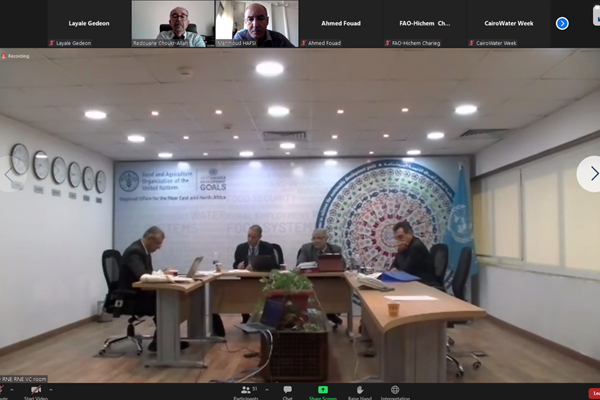
The Joint Technical Secretariat of the Joint Water-Agriculture Council of the League of Arab States organized on 26 October 2021, with support from AODA, ESCWA and FAO-RNE, the Third Meeting of High-Level Joint Water-Agriculture Technical Committee (HLJTC) and that will take place virtually on the sidelines of 2021 Cairo Water Week.
Water Governance
31/03/2022
Capacity Development and Related Services for an Integrated Sustainable Development and Management of the Water Sector in the Kingdom of Saudi Arabia in the framework of the VISION 2030
Capacity Building
20/05/2019
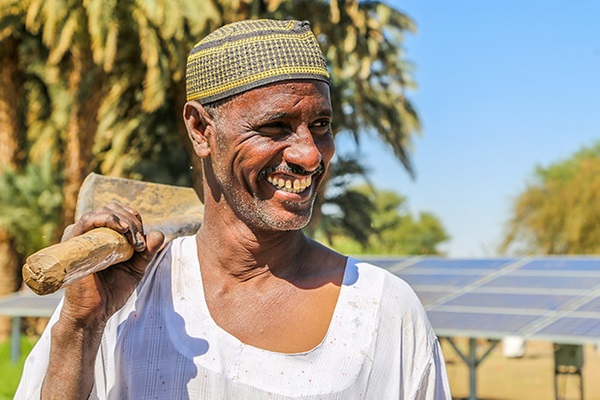
The project aims to develop and accelerate the adoption of off-grid solar pumping for irrigation by providing demonstration units, technical capacity building, a quality-assurance mechanism, and a financing mechanism.
Resilience and Climate Change Adaption
30/11/2016
The goal of this project, "Building Resilience in the Agriculture and Water Sectors to the Adverse Impacts of Climate Change in Sudan", is to contribute to reduce the vulnerability and increase the adaptive capacity of Sudan's agriculture sector to climate change impacts.
Resilience and Climate Change Adaption
31/07/2017
The Federal Government of Somalia (FGS) requested a Drought Impact and Needs Assessment (DINA) and subsequent Resilience and Recovery Framework (RRF) in August 2017 to identify the root causes of recurrent drought and develop a strategy for medium term recovery and long-term resilience.
Water Governance
31/12/2020
GoAL WaSH, implemented through UNDP Country Offices, was managed strategically by the UNDP-SIWI Water Governance Facility (WGF), housed by the Stockholm International Water Institute (SIWI). The GoAL WaSH country program designs were based on dialogue among different levels of government, the UNDP country offices, and the UNDP–SIWI WGF.
Non-Conventional Water Resources
30/11/2015
Towards Improving Water Quality and Expanding International Cooperation in Water and Sanitation Related Program, AWC has Launched an “Arab Non-Conventional Water Resources Initiative” (ANCWRI) to address water scarcity challenges in cooperation with UNESCO’s Bureau for Science and Technology for the Arab region in Cairo.
Water Governance
31/03/2015
This document represents the third State of the Water Report for the Arab Region, and is hopefully intended to provide beneficial guidance to the water sector decision making process to support better water planning, management and development.
Water Productivity Tools and Analytics
31/05/2018
A rapidly changing climate, greater exposure to disaster risks, and trends of land degradation, food and water insecurity, present an unprecedented challenge for development in the Arab region.
Water Governance
27/03/2016
The objective of the Project is to improve water resources and agricultural management and planning within and across the beneficiary Countries, based on qualitative and spatial-based decision making tools.