


iRTP-WS team showcases innovation and integrated solutions at Cairo Water Week 2025
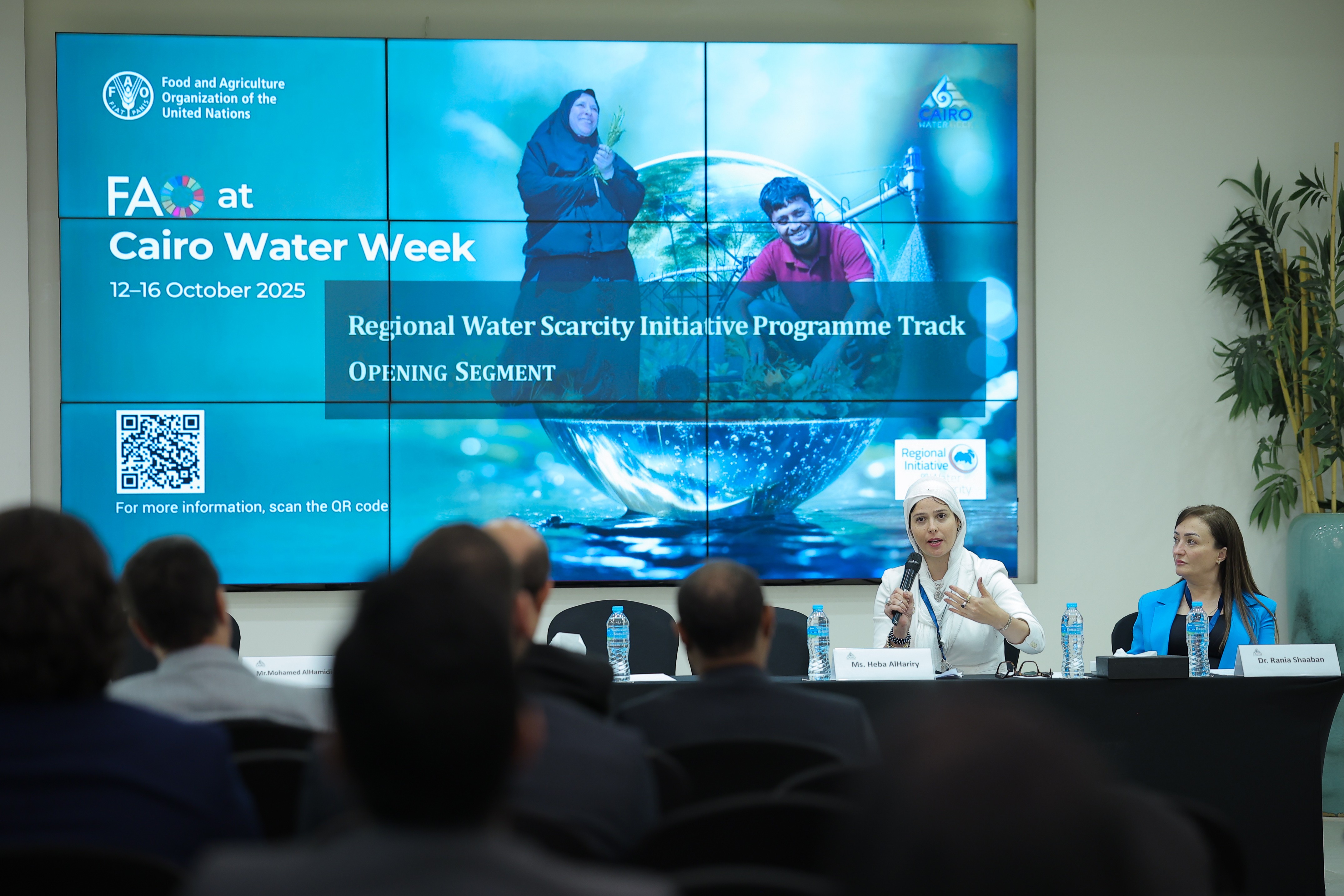
The FAO Inter-Regional Technical Platform on Water Scarcity (iRTP-WS) played an active role during Cairo Water Week 2025, held under the theme “Water for Climate Action.” Through a series of technical sessions, the Platform’s team highlighted FAO’s commitment to advancing innovation, resilience, and evidence-based decision-making for water-resilient agrifood systems.
Dr Ehssan El Meknassi, Technical Specialist, contributed to two high-level discussions illustrating the Platform’s integrated approach to water scarcity and sustainable development. On 12 October, during the session “Implementing and Institutionalizing Water Accounting Innovation in Egypt,” she presented ongoing iRTP-WS efforts to strengthen data-driven decision-making through the Water Accounting approach, introducing the WatNex Tool Engine training to build national capacities for integrated WEFE planning. On 13 October, in the session “Tracking Resilience and Shaping Solutions for a Climate-Stressed Region,” she highlighted adaptive governance mechanisms and nature-based solutions under Solution Package 3 (Nexus for Resilience), showcasing how integrated landscape approaches can enhance productivity and foster inclusive, community-led management of natural resources.
Dr Heba Al Hariry, Land and Water Officer at FAO-RNE, represented iRTP-WS in several key sessions promoting innovation and sustainability in the MENA region. During the session “Green Transition for Sustainable Agriculture in MENA,” convened by ICARDA, MIT, and Oregon State University, she presented “Scaling up WEFE Practices for Innovative Use of Renewable Energy in Irrigated Agriculture.” Her intervention highlighted the integration of renewable-energy solutions in irrigation systems to improve efficiency, reduce emissions and strengthen resilience, drawing on examples from Bangladesh, India, Colombia, Mexico, Morocco and Malawi.
Dr Al Hariry also spoke at the FAO session “Harnessing Artificial Intelligence for Sustainable Water Resources Management and Governance,” demonstrating how Artificial Intelligence is being integrated into the upcoming iRTP-WS workplan to enhance modelling, forecasting and decision-support systems across all Solution Packages. She concluded with a call for collaborative action to scale up innovation and strengthen partnerships for water-secure and climate-resilient agri-food systems.
These interventions reaffirmed iRTP-WS’s growing contribution to promoting integrated, technology-driven, and cross-regional solutions for sustainable water management and resilient agriculture.
_page_01_image_0001.jpg?sfvrsn=f2a9da47_3)