


Blog
Evidence must be fit for purpose to support science and innovation for people and planet
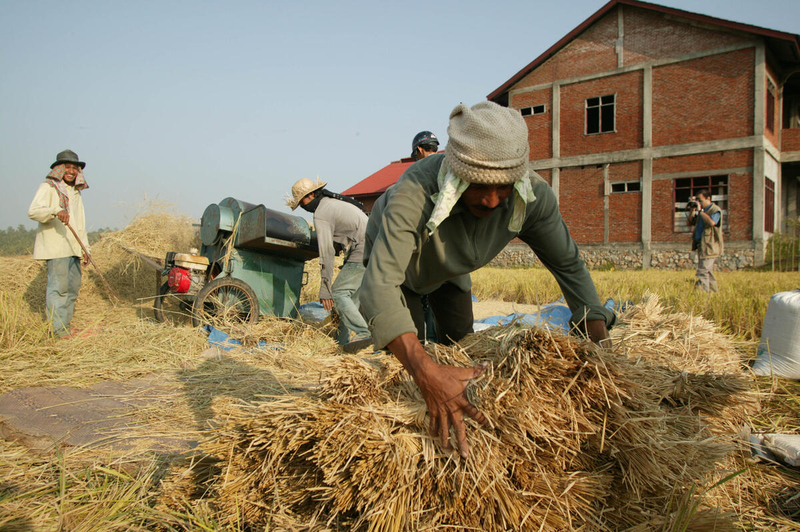
©FAO/Jim Holmes
Continued investment in science, technology and innovation is critical for meeting the challenges of food security and sustainable development and to achieve better production, better nutrition, better environment and a better life. A core principle of the FAO Science and Innovation Strategy is that it should be evidence-based. Good evidence is vital to support good decision-making and to drive innovation. But which evidence? Evidence produced by whom? For whom? And for what purpose?
We often think of “evidence” as inherently objective. But all evidence is produced in a context – the generation of evidence is inevitably shaped by a range of factors. These include public policy and research funding as well as private interests, dominant scientific paradigms and the values and worldviews embedded in society. These factors need to be understood and managed, and taken into account when evidence is assessed, so that evidence can effectively support policy and practice.
For millennia, agrifood systems have been driven by evidence produced by farmers, pastoralists, fisherfolk, hunters and gatherers who adapted their practices in managing the natural resources and ecosystems from which they drew their livelihoods. Through trial and error and the accumulation of traditional and indigenous knowledge, communities of such ecosystem managers evolved customary practices of sustainable use of wildlife, developed new varieties of crops and livestock, and identified ways of protecting their crops from pests, diseases and other threats. As acknowledged in the FAO Strategy, the knowledge of Indigenous Peoples and small-scale producers remains vital today.
More recently, specialized research activities employing the scientific method involving experimentation, the rigorous testing of hypotheses, and clear processes for verification, have allowed for the acceleration of knowledge generation and innovation. This has enabled the elucidation of fundamental principles, advanced our understanding and led to many technological developments in the agricultural sector, supporting improvements in productivity.
During the last century publicly-funded research largely focused on increasing yields of major crops and livestock. As such, this has tended towards a reductionist approach, focusing on simplified subsets of complex socio-ecological systems. While generally successful in meeting its own objectives, the results were sometimes divorced from the knowledge, needs, and realities of small-scale producers, particularly women farmers, and environmental impacts were externalized. Siloed approaches have led to sub-optimal outcomes for food security, water security, health and the environment.
Moreover, during the latter part of this period and since, research priorities have been increasingly influenced by large corporations, including through privately funded research, whose interests entail increasing profits rather than supporting food security. A number of factors, including biases related to scale, overspecialization, short-term thinking and private vested interests, can lead to the research agenda being “locked-in” to certain paradigms. For example, some major companies promote technical packages of advanced crop varieties, fertilizers and pesticides as well as dedicated information services, that must be accepted as a whole, reducing the agency of the farmer to adapt or modify practices.
The FAO Science and Innovation Strategy recognizes that a renewed approach is required to leverage science and innovation to overcome current complex social, economic and environmental challenges to support food security, livelihoods and sustainability. The Strategy emphasizes that evidence should be credible, relevant and legitimate, draw upon the full range of the natural and social sciences, as well as the knowledge of Indigenous Peoples and small-scale producers, and requires that evidence be assessed in a rigorous, transparent and neutral manner.
To be credible, evidence must be generated in a transparent and robust process: the sources of data and knowledge should be clear, methods should be reproducible and conclusions should be subject to a robust process of verification. Conventional science depends on peer review and the ability of independent researchers to reproduce – or challenge – results while, many indigenous and local knowledge systems are empirically tested, applied, contested and validated through different means in different contexts. Competing interests must be examined and avoided or managed. This obviously applies to research funded by companies with a vested interest in a product but might also apply to a group of landowners who are defending a particular management practice and even to a research body or foundation that has invested in a particular paradigm or worldview.
To be relevant, evidence needs to address the issues that address current challenges of food insecurity, inequality and poor health, climate change, biodiversity loss, land degradation and pollution. Most food is still produced by small-scale family farmers in relatively diverse landscapes. It follows that to be relevant, research should focus on developing the knowledge that supports such producers and to achieve this, such producers need to be engaged in this research.
To be legitimate, evidence generation should follow established scientific methods and principles and ethical standards. Where it involves the rights and interests of Indigenous Peoples and small producers it should ensure their full and effective participation and respect their rights. At a minimum this should include adherence to and respect for the UN Declaration on the Rights of Indigenous Peoples, the UN Declaration on the Right of Peasants and Other People Working in Rural Areas, and the right to food and other human rights.
Because agrifood systems are inherently complex socio-ecological systems that are required to support multiple societal objectives, interdisciplinary and transdisciplinary approaches, drawing upon the social sciences and humanities as well as the natural sciences are needed to address these inter-related problems in a holistic way. Greater efforts are needed to overcome barriers between disciplines of knowledge and to transcend different value systems, worldviews and ways of knowing. Equally, participatory approaches are essential to engage small-scale producers and indigenous and local communities, and to ensure that research is gender aware and gender responsive.
Programmes that support research and experimentation in partnership with farmers including Farmer Field Schools, championed by FAO, and Participatory Plant Breeding demonstrate that farmers’ needs can be met, while utilizing their local knowledge and maintaining rigorous approaches to knowledge generation.
Established science-policy interfaces such as the Intergovernmental Panel on Climate Change (IPPC) and the Intergovernmental Science-Policy Platform on Biodiversity and Ecosystem Services (IPBES) provide a gold standard for evidence assessment. Multidisciplinary teams of experts synthesize and assess the peer-reviewed scientific literature to develop reports that are reviewed by external experts and governments. Governments define the scope of the assessment and approve the main findings. In addition, IPBES has developed an approach to recognizing and working with indigenous and local knowledge, based on effective dialogue between indigenous and local knowledge holders and other experts. The 2019 IPBES Global Assessment on Biodiversity and Ecosystem Services showed that the governance and management systems of Indigenous Peoples and local communities often contribute to maintaining and enhancing biodiversity and reducing habitat loss. The Committee on World Food Security has also developed a robust process for assessing evidence through its interdisciplinary High Level Panel of Experts on Food Security and Nutrition. Its report on Agroecological and other innovative approaches for sustainable agriculture and food systems that enhance food security and nutrition, underlines the need for holistic approaches.
The UN Secretary General has called for an accelerated transformation of food systems to meet today’s challenges of food security, economic security and environmental sustainability. Science and innovation is key to achieving this ambition; it must be underpinned by sound evidence that draws upon the whole of humanity’s knowledge. Policy makers, scientists, farmers and other small-scale producers, Indigenous Peoples and local communities must all work together, and learn together, to ensure a just and sustainable future.
 Dr. David Cooper is a Visiting Fellow at the Oxford Martin School and Honorary Researcher in the Leverhulme Centre for Nature Recovery, School of Geography and the Environment. He is Chair of the UK Joint Nature Conservation Committee, former Acting/Deputy Executive Secretary of the UN Convention on Biological Diversity, and former staff member of the UN Food and Agricultural Organization. He has contributed to numerous scientific assessment processes and was instrumental in facilitating the development and adoption of the Kunming-Montreal Global Biodiversity Framework. He writes in a personal capacity.
