


Capacity needs assessment tool: School-based food and nutrition education
01/01/2021
The capacity needs assessment tool is meant to be used by national and local groups as a foundation for the design of school-based food and nutrition education capacity development strategies.

Stepping up – Everyone around the table for better nutrition and healthy diets
01/01/2021
This is a series of papers intended to highlight current understandings, gaps and misconceptions about engaging with businesses in the food system.

Enabling sustainable food systems. Innovators’ handbook
31/12/2020
This handbook is written for “sustainable food systems innovators” by a group of innovators from Asia, Africa, the Americas and Europe who are leading initiatives to grow, share, sell and consume more sustainable foods in their local contexts. It includes experiences that are changing the organizational structures of local food systems to make them more sustainable.
6bc38856-6e88-4c18-8ebf-ea0d54aead6a.tmb-th600x400.png?Culture=en&sfvrsn=bc2a61f8_1 "Untitled design (39)")
System for Earth Observation Data Access, Processing and Analysis for Land Monitoring (SEPAL)
01/12/2020
SEPAL (System for Earth Observation Data Access, Processing and Analysis for Land Monitoring) is an open-source project and platform empowering people around the world to gain a better understanding of land cover dynamics by facilitating the efficient access and use of Earth observation data.

Toolkit for value chain analysis and market development integrating climate resilience and gender responsiveness. Integrating agriculture in National Adaptation Plans (NAP-Ag) Programme
01/09/2020
This toolkit aims to help countries in selecting and analysing value chains for opportunities to improve climate change resilience and reduce gender inequalities. It intends to provide policy makers, planners, project developers, technical advisors and implementers at local, regional or national level with good practices of climate-resilient and gender-responsive value chain development.

School Meals Coalition
01/01/2020
The School Meals Coalition is an emerging initiative of governments and a wide range of partners to drive actions that can urgently re-establish, improve and scale up food and education systems, support pandemic recovery and drive actions to achieve the Sustainable Development Goals (SDGs).
94f77d5b-0893-40c0-9578-b48318c90af3.tmb-th600x400.png?Culture=en&sfvrsn=e087b59d_1 "Untitled design (51)")
Methodology for Quantification of GHG Emission Reductions from Improved Management in Smallholder Dairy Production Systems using a Standardized Baseline
31/12/2018
This methodology presents requirements for development and assessment of a standardized baseline for quantification of greenhouse gas (GHG) emission reductions in smallholder dairy systems.
c91cfe8c-b9e3-473b-b0ec-e3848f9dcac2.tmb-th600x400.png?Culture=en&sfvrsn=a2bce7c2_3 "Untitled design (5)")
Empowering youth to engage in responsible investment in agriculture and food systems - Rapid capacity assessment tool
01/12/2018
This rapid capacity assessment tool aims to help practitioners (such as government agencies, youth organizations, or development partners) to carry out a multi-stakeholder assessment of existing and needed capacities to engage and empower youth to carry out and benefit from responsible investment in agriculture and food systems.

A Toolkit on gender-sensitive social protection programmes to combat rural poverty and hunger
01/12/2018
FAO has developed the Technical Guidance Toolkit on Gender-sensitive Social Protection Programmes to Combat Rural Poverty and Hunger. The Toolkit is designed to support social protection and gender policy-makers and practitioners in their efforts to systematically apply a gender lens to social protection programmes in ways that are in line with global agreements and FAO commitments.
384b3987-abcc-469e-b1b2-4e03954eb8f2.tmb-th600x400.png?Culture=en&sfvrsn=3f9a57fb_1 "Untitled design (38)")
Water productivity through open access of remotely sensed derived data portal (WaPOR)
01/12/2018
The WaPOR portal provides publicly accessible, near real-time data to monitor agricultural water productivity, using innovative satellite technology.
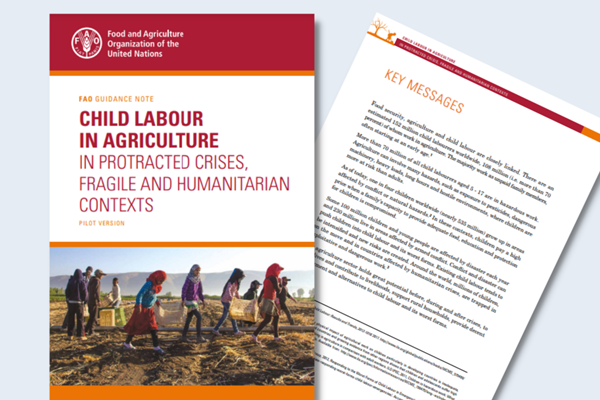
FAO Guidance Note: Child labour in agriculture in protracted crises, fragile and humanitarian contexts
31/12/2017
This note provides technical and operational guidance to stakeholders of the agriculture, food security and nutrition sector intervening in protracted crises, fragile and humanitarian contexts to ensure that children are not engaged in activities that could negatively affect their health, development or education, and are not employed in hazardous working conditions.
.tmb-th600x400.png?Culture=en&sfvrsn=8cf3fc9f_2 "Untitled design (85)")
FAO/WHO Diagnostic tool for assessing status of national Codex programmes
31/12/2017
The purpose of this Codex Diagnostic Tool is to provide a framework for countries to carry out a self-assessment of the current status of the national Codex programme.
9ae02953-16e4-487c-8aaa-431b556a5992.tmb-th600x400.png?Culture=en&sfvrsn=1509d8db_1 "Untitled design (6)")
Global Livestock Environmental Assessment Model (GLEAM)
01/12/2017
GLEAM is a modelling framework that simulates the interaction of activities and processes involved in livestock production and the environment. The model can operate at (sub) national, regional and global scale. GLEAM differentiates key stages along livestock supply chains such as feed production, processing and transport; herd dynamics, animal feeding and manure management;...
0b024510-ae87-431c-8a6d-732c9095e7be.tmb-th600x400.png?Culture=en&sfvrsn=3f105459_1 "Untitled design (7)")
Investing in Sustainable Energy Technologies in the Agrifood Sector (INVESTA) methodology
01/12/2017
The “Investing in Sustainable Energy Technologies in the Agrifood Sector” (INVESTA) methodology provides guidelines for a sound and comprehensive cost-benefit analysis (CBA) of clean energy interventions in agrifood value chains and compares the economic net benefits (including hidden costs and co-benefits) with a simple financial analysis to inform investors.
3998538f-5713-4254-87e9-a2cd0e6be086.tmb-th600x400.png?Culture=en&sfvrsn=c8e27b3a_12 "GSP")
Global Soil Partnership
01/12/2012
The Global Soil Partnership (GSP) is a globally recognized mechanism established in 2012 with the mission to position soils in the Global Agenda and to promote sustainable soil management. The Partnership, hosted by FAO, works hard to improve soil governance to guarantee productive soils towards food security, climate change adaptation and mitigation, and sustainable development for all.

Global Bioenergy Partnership
01/12/2006
Bringing together public, private and civil society representatives, the Global Bioenergy Partnership (GBEP) is a voluntary-based global initiative devoted to facilitate the development of sustainable bioenergy.

The Mountain Partnership
01/12/2002
The Mountain Partnership advocates for global attention and tangible commitments from the international community to achieving sustainable mountain development.