

Ressources
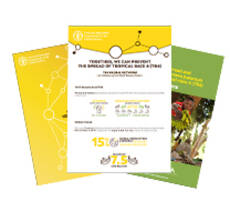
Ensemble, nous pouvons enrayer la propagation de Fusarium RT4.
Il est essentiel d’investir dans l’agriculture, notamment dans l’innovation du secteur bananier, pour améliorer la productivité et instaurer des systèmes de production alimentaire durables, indispensables pour atteindre l’objectif #Faim Zéro. Destinée au grand public, la brochure intitulée « Ensemble, nous pouvons enrayer la propagation de la TR4 » souligne l'importance cruciale des bananes et des bananes plantains, non seulement pour leur valeur économique, mais aussi pour leur profond enracinement culturel à travers le monde. Elle présente également les principales stratégies pour lutter contre Fusarium race tropicale 4 (RT4), responsable de la fusariose du bananier.
Search resources
Impact and Control of Transboundary and Invasive Banana (Musa spp.) Wilt Pathogen, Fusarium oxysporum f. sp. cubense
Identification of Aspartate Aminotransferase FocAST2 as a Novel Target of Albendazole in Fusarium oxysporum f. sp. cubense TR4
Effect of plant elicitor Isotianil on the rhizosphere soil microbiome composition of banana cultivars with different resistance to Fusarium wilt
High-Throughput sequencing: A tool to curb banana diseases of quarantine importance
Mechanistic insights into selenium-driven activation of antioxidant enzyme system in bananas against Fusarium wilt pathogen
QCAV-4, the first genetically modified Cavendish (cv. Grand Nain) banana resistant to Fusarium wilt tropical race 4 approved for commercial production and consumption
High-Throughput sequencing: A tool to curb banana diseases of quarantine importance
Endophytic bacteria and rhizosphere bacteria jointly inhibited the outbreak of banana wilt
Protecting Puerto Rico agriculture: A predictive perspective on resistance gene candidate RGA2 against Fusarium oxysporum f. sp. cubense tropical race 4 in Musa spp.
Transcriptome-wide identification and characterization of Musa circular RNAs in corm and root tissues of resistant and susceptible cultivars in response to Fusarium oxysporum f.sp. cubense race1 and TR4
The views expressed in this information product and the articles above are those of the author(s) and do not necessarily reflect the views or policies of FAO.