


Module 4
Household livelihoods
The module 4 corresponds to impacts on beneficiary households where LAPs seek security and legal certainty about land ownership.
Intervention levels


This guide contains 5 modules, which allow users to proceed independently of the tool’s own logic. The modules contain numerous external hyperlinks to access a bank of technical documents of the FAO, World Bank and other additional information sources. They also contain internal hyperlinks for navigating between modules or for easy access to the tool’s glossary.

Devising hypotheses and intervention variables
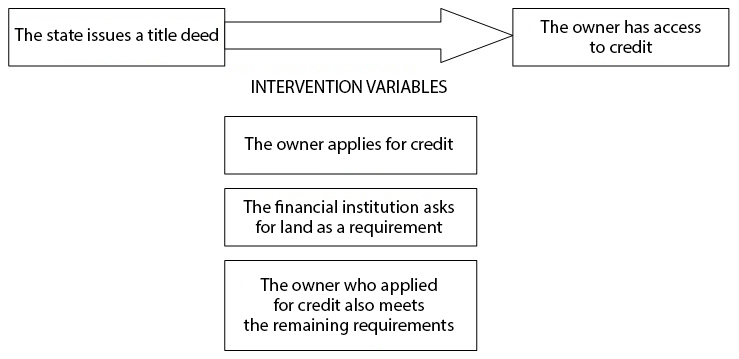
o establish cause-effect relations, a logic model based on change theory must be developed, which explains the action of the programme and the expected effect on the population. It forms the basis for the causal chain which we assume occurs once the project has started; this relation between causes and expected effects is what we will call the hypothesis. Very occasionally, however, an effect is caused by just one cause, while there are other factors that influence the relation between the actions and effects of the project; contextual variables which limit or accelerate this phenomenon are called intervention variables.
To construct hypotheses, the causal relation between the action and expected effects of the programme should be considered, in addition to specific aspects which may affect the expected outcome. For example, as regards access to credit, the numbers should be determined not only of those who received a new title who were given credit, but also of people applying for credit, how many met the bank’s requirements and what proportion of those obtained it. It is consequently important to establish appropriate hypotheses for each of these aspects, defining the direct variables of the intervention and those affecting how the outcomes are obtained.
See Fact sheet for designing and processing household surveys for further details on the hypotheses.
Logical sequence between the action and expected effect of the programme
Practical evaluation guide
Fact Sheets
External links and bibliography
- Voluntary guidelines on the responsible governance of tenure of land, fisheries and forests
- Land governance assessment framework
- Global land tool network: land administration and information
- Sustainable livelihoods guidance sheets
- Global Land Indicators Initiative (GLII)
- Guía Metodológica: Módulo de Comunicación y Capacitación sobre Tierras Comunales
- Vídeo: Reconocimiento de tierras comunales y gobernanza local en Guatemala
Extra sections
With the patronage
