A regional review of 82 food plants used by Indigenous Peoples shows strong reliance on wild native bees and other specialized pollinators. As habitats decline, plant–pollinator networks-and food security for IPLC-face rising vulnerability across Latin America.
A study on the endangered Bombus affinis shows that native-plant yards in cities can create connected micro-habitats that support wild pollinators. When households plant intentionally, urban areas function as ecological corridors for pollinator recovery.
An EEA briefing warns that Europe’s wild pollinators are rapidly declining. It calls for robust pollination indicators, harmonised monitoring, reduced pesticide pressure and habitat restoration to guide effective EU policy and halt biodiversity loss.
Ancient grasslands with long habitat continuity host far richer bee and hoverfly communities than newly created sites. The study shows that restoring pollination services requires connecting new patches to old and continuous habitats.
A modelling study finds that a collapse of wild pollinators in Europe by 2030 could shrink crop yields by ~8%, cost global agri-food welfare €34 billion, and push Europe to become a net importer of nutrient-rich foods.
Across Africa, baobab trees rely on different nocturnal pollinators, bats in West Africa and moths in the South. Their flowers have co-evolved accordingly, showing why pollination ecology must guide restoration and conservation strategies.
A three-year garden study in Oregon shows pollinators consistently prefer wild-type native plants over cultivars. Native species supported higher pollinator richness and specialist bees, highlighting the importance of minimally modified plants for sustaining pollinator communities.
A global meta-analysis in Science identifies critical habitat thresholds for wild pollinators, 6 % for hoverflies, 16 % for solitary bees, 18 % for bumble bees, and 37 % for butterflies, showing that conserving connected, high-quality habitats is key to sustaining pollination.
The APES framework, developed under the Horizon 2020 RADIANT project, links agroecological practices to 22 ecosystem services. Tested on dairy farms in Northern Italy, it shows how interacting practices generate tangible ecosystem benefits and guide sustainable transitions.
In Zimbabwe, the Farming with Alternative Pollinators approach integrates marketable habitat plants along field edges. Results show higher wild pollinator diversity and farmer incomes, proving agroecological design can boost both biodiversity and livelihoods.
In central Lao PDR, Apis cerana thrives in agroecological systems but declines under intensive farming. The study shows that floral diversity and abundance, more than area alone, drive bee presence, highlighting agroecology as key to sustaining crop pollination.
In Mongolia, scientist Solongo Ganbold turned bee venom research into a start-up, Magic Bee Foods. Supported by FAO, her venture develops balms and ointments, creates rural jobs for women, and shows how science, innovation, and empowerment can reshape agrifood systems.
Native pollinators sustain food systems and ecosystems in the Himalayas but face climate-driven shifts. Research highlights urgent need for monitoring, DNA barcoding, and conservation strategies linking science and local knowledge.
Two-year study of 33 sites shows bee responses vary with season: spring bees depend on landscape-level resources, while summer–fall bees rely on local floral conditions. Intensive agriculture reduces species richness, underscoring the need for multi-scale, seasonal conservation.
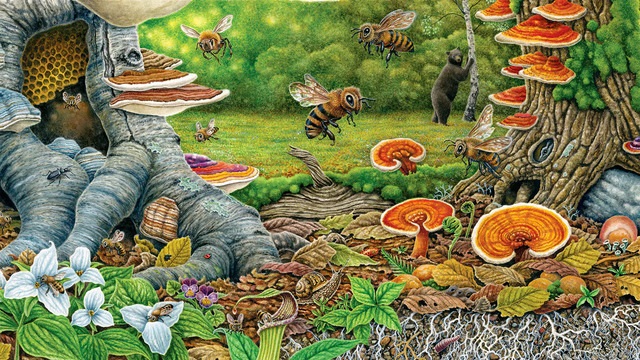
When honey bees sip droplets from mushrooms, it’s more than a forest curiosity. Research shows fungal extracts can slash bee virus loads thousands-fold, revealing biodiversity as hidden infrastructure vital to pollinator health and resilient food systems.
Adaptive beekeeping initiatives in Africa, Europe, and North America show how training, infrastructure, and tailored support enable persons with disabilities to generate income, gain confidence, and engage in community life through inclusive apiculture.
FAO, Embrapa, and ABELHA empower rural women in Pará, Brazil, through stingless beekeeping training. The manual covers native bee ecology, hive management, honey processing, and product marketing, fostering biodiversity, income, and gender equity.