Climate Change

25/06/2026
The COP31 Turquoise Nexus Initiative (TNI) was presented on 16 June 2026 to governments, international organizations, development partners and technical experts during the UNFCCC June Climate Meetings (SB64) in Bonn. The event underscored the urgency of addressing the interconnected challenges of food insecurity, water scarcity and climate change through more coordinated approaches.
16/06/2026
While the food, water, and climate crises are deeply interconnected, national climate commitments rarely reflect coordination across water, agriculture, water, food security, and adaptation measures. The Turquoise Nexus Initiative (TNI) —an initiative of Türkiye that will be formally launched at COP 31—aims to address this fragmentation by creating a global mechanism that will integrate food systems transformation, sustainable water management, and climate adaptation.
16/06/2026
There are days when the sky does not bring rain. Instead, a thick fog, called camanchaca, advances silently from the ocean and covers hills and ravines. The trees, plants and its animals welcome this humidity. But crops and communities miss the needed rain. Now, in Chile’s Peña Blanca agricultural community, this fog is being captured drop by drop and transformed into the missing water.
09/06/2026
A new El Niño phase is likely to begin within weeks, putting agriculture on alert around the world. A new analysis from the Food and Agriculture Organization of the United Nations (FAO) maps where El Niño-linked drought is most likely to impact crops and pasturelands, raising risks for agricultural-dependent livelihoods and food security in regions already in crisis.
02/06/2026
Agriculture and food systems are highly vulnerable to climate impacts, but they are also major contributors to greenhouse gas emissions. With over 8% of the world’s population, around 673 million people, not getting enough to eat, experts gathered for the Expert Meeting on Agriculture and Food to consider how to feed the growing world population while responding to climate change. The meeting is being co-sponsored by the Food and Agriculture Organization of the United Nations (FAO) and the Intergovernmental Panel on Climate Change (IPCC).
01/06/2026
Countries are moving from formulating climate adaptation plans to implementing concrete actions, but to fully succeed, a massive scaling up of targeted adaptation finance is needed. This was the message that came through loud and clear at NAP Expo 2026, held in Kigali, Rwanda, from 18-21 May, where countries’ perspectives shaped wide-ranging agenda.  
26/05/2026
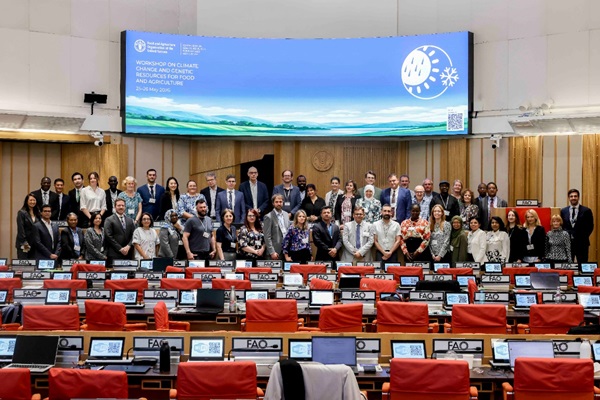
Participants at the Workshop on Climate Change and Genetic Resources for Food and Agriculture, convened at FAO headquarters, 25–26 May 2026, underscored the critical role that genetic resources play in strengthening the resilience of agrifood systems in the face of climate change.
No soil, no problem
27/04/2026
Hydroponics offers an innovative and climate-smart solution to family farmers in Grenada
The heat is on
21/04/2026
Heat just used to be part of the job for Sary Kea, a rice farmer in Cambodia’s Northern Tonle Sap Basin. Until it started hurting her harvest. In the last few years, extreme heat caused major losses in rice harvests.
22/04/2026
New FAO-WMO report assesses risks and identifies adaptation options as rising temperatures pose hazards to people, crops, livestock and fish.
©FAO/Denni Visuals
27/03/2026
The Green Climate Fund (GCF) has approved a $50 million project, supported by the Food and Agriculture Organization of the United Nations (FAO), to enhance the climate resilience of vulnerable smallholders in Jamaica.
Why agricultural heritage systems matter for biodiversity and climate resilience
24/03/2026

What if the key to feeding future generations isn't hidden in new technology but preserved in the world's agricultural heritage systems?

Agricultural heritage is at the heart of every culture; it is the link between the past and the present. It paves the way for a food-secure future.

...
Observing today, protecting tomorrow: How climate services save livelihoods
23/03/2026

Over two billion people depend on agriculture for their livelihoods. The vast majority are smallholder farmers, whose daily decisions on when to sow or irrigate are essentially tied to the weather. Without reliable information, they can be caught off-guard.

The odds are worsening, as ext...

Transparent data, stronger agrifood action: Colombo workshop sets direction for COP31
16/03/2026
Countries across Asia-Pacific and Central Asia are stepping up efforts to meet their climate commitments. A regional workshop held in Colombo delivered a clear and unified message: more transparent data and reporting systems, deeper regional cooperation and targeted action through agrifood systems are essential to accelerating climate action and ensuring measurable progress, leading to greater food security and better livelihoods.
Why women farmers are an overlooked force in climate action
05/03/2026

Women are a powerful accelerator of change, from farms and cooperatives to national policy and global climate action, yet too often they are sidelined in rights and resources,” writes Piedad Martin in an 

Translating climate policies into real-world solutions
05/02/2026
Climate change is having a profound impact on farmers in Cambodia. Rising temperatures—which have increased at a rate of +0.23 °C per decade since 1950—combined with highly variable rainfall patterns, are disrupting agricultural livelihoods across the country. Farmers face increasing dry spells, ...
© FAO/Rafa Stedile
10/02/2026

Agricultural losses are accelerating as weather extremes intensify. According to a quantitative assessment using data from FAOSTAT and FAO's Emergency Events Database, climate-related disasters cost global agriculture an estimated

19/11/2025
On Food and Agriculture Day, key stakeholders in action to transform agrifood systems and mitigate super-pollutants combined forces to discuss ways to unlock the finance needed to deliver results for the climate.
03/10/2025
The Food and Agriculture for Sustainable Transformation (FAST) Partnership, launched at COP27, is a multi-stakeholder platform created to tackle one of the toughest challenges for agrifood systems: unlocking access to climate finance at scale.
25/11/2025

FAO convened a two-day workshop on Plastics and One Health in Agrifood Systems, bringing together global experts to discuss the risks and impact pathways of plastic pollution. It was a chance to strengthen a shared understanding of how these interconnected issues ...