


Completed evaluations

Evaluation of the "Food-loss reduction through improved postharvest handling and value-addition of key fruits and vegetables" project in Ethiopia
22/07/2021
By tackling post-harvest losses, the project addressed one of the major challenges faced by producers. Farmers have adopted project post-harvest management practices, techniques and technologies that have helped to reduce losses and increase food security by boosting income and making more produce available for household consumption.

Evaluation of the project “Developing capacity for strengthening food security and nutrition in selected countries of the Caucasus and Central Asia"
22/06/2021
The FAO project on developing capacity for strengthening food security and nutrition in selected countries of the Caucasus and Central Asia aims to promote cross-sectoral collaboration between agriculture, health, education and social protection sectors by carrying out six pilot projects in Armenia, Kyrgyzstan and Tajikistan.

Terminal evaluation of the project “Integration of climate resilience in agricultural and pastoral production for food security in vulnerable rural areas through the farmer field school"
22/06/2021
This is the final evaluation report of a project that aimed to strengthen the agricultural and pastoral sectors’ climate change adaptation (CCA) capacities in the Niger.

Evaluation of the project "Integrating Agriculture into National Adaptation Plans (NAP-Ag)"
22/06/2021
The Integrating Agriculture into National Adaptation Plans (NAP-Ag) programme, jointly coordinated by UNDP and FAO, worked with eleven countries to identify and integrate climate adaptation measures into national planning and budgeting processes, in support of achieving the Sustainable Development Goals (in particular SDG 2 - Zero Hunger; and SDG 13 - Climate Action) and the Paris Agreement.
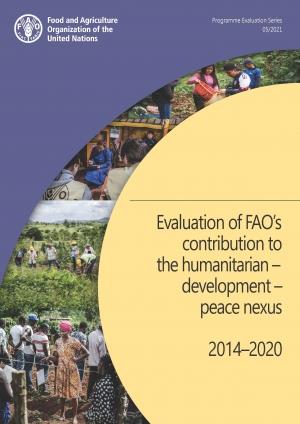
Evaluation of FAO’s contribution to the humanitarian–development–peace nexus 2014–2020
07/06/2021
The Evaluation of FAO’s contribution to the humanitarian–development–peace (HDP) nexus revisits and brings together in a coherent narrative the many approaches of conflict management and peace-sustaining work carried out over the years on natural resources management and rights-based frameworks. It analyses the body of work developed through emergency activities, in crisis and conflict contexts – shaped by the ever-stronger recognition of the need to focus on longer-term resilience.

Review of the FAO corporate surge response in Yemen 2017–2019
07/06/2021
Yemen is now home to the world’s worst humanitarian crisis with half of its population facing severe acute food insecurity despite ongoing humanitarian food assistance. To meet the demands for active learning, the FAO Office of Evaluation (OED) conducted a review of the FAO Yemen corporate surge response systems, structure, strategy and delivery.

Evaluation of the project “Strengthening the role of women in peacebuilding through natural resources management at the community level in the rural areas of the governorates of Sana’a and Lahaj in Yemen”
07/06/2021
Women have traditionally played a role in water conflict resolution in rural areas. The most transformative change the project has achieved is the institutionalization of this role through the Water User Associations (WUAs) so that women gain further acceptance within their communities.

Evaluation of projects related to the Voluntary Guidelines on the Responsible Governance of Tenure of Land, Fisheries and Forests in the Context of National Food Security funded by Germany
07/06/2021
FAO has been promoting the Voluntary Guidelines on the Responsible Governance of Tenure of Land, Fisheries and Forests (VGGT) in several countries and the Federal Republic of Germany had significantly contributed by financially supporting FAO’s activities. The programme contributed through multi-stakeholder platforms to an inclusive dialogue which led in most countries to the emergence of a common vision on land governance and positively influenced the land reform processes.

Programme Evaluation Report 2021
12/05/2021
This Programme Evaluation Report (PER) outlines some of the highlights of the 95 evaluations conducted by the FAO Office of Evaluation (OED) in the period 2019–2020. These include evaluations of Country Programmes and projects, thematic strategies, resilience and emergency evaluations, FAO’s statistical work and the strategic results framework, as well as the first evaluations in a series on FAO’s contributions to the SDGs.

Evaluation of FAO’s support to climate action (SDG 13) and the implementation of the FAO Strategy on Climate Change (2017)
04/03/2021
This evaluation assesses the extent to which FAO adopted an effective, coherent and transformative approach to its work on climate action from 2015 to 2020, by contributing to the achievement of SDG 13 targets and the Paris Agreement.