


Publications

Changing the terms of women's engagement in cocoa and coffee supply chains
06/05/2019
In this report FAO, Royal Tropical Institute of the Netherlands (KIT) and TWIN present the gender inequalities in the cocoa and coffee sectors and the underlying causes. The report also shows how these inequalities can be addressed systematically and features case studies focusing on: women’s participation and leadership in producer organizations, women’s access to land, the household approach and innovations in extension services. 104 pp.
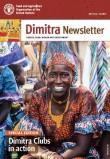
Dimitra Newsletter | Special edition | April 2019 – Issue #30
23/04/2019
This newsletter gives an overview of the impact the Dimitra Clubs are having on rural communities. Featuring success stories and some results, this special edition focuses on food security and nutrition, gender and women’s leadership, community mobilization, social cohesion and peace, climate change adaptation, rural organizations, access to information and sharing of knowledge, and the voice of the youth. 68 pp.
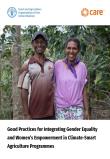
Good practices for integrating gender equality and women’s empowerment in climate-smart agriculture programmes
27/03/2019
This paper builds on efforts to guide practitioners and planners in the development and implementation of gender responsive climate-smart agricultural programming, using existing evidence and lessons learned from many development programmess carried out worldwide. It presents a set of agricultural practices implemented by small-scale food producers in developing countries. 112 pp.

Ethiopia: National gender profile of agriculture and rural livelihoods (Country Gender Assessment Series)
25/03/2019
This assessment analyses the agricultural and rural sectors with the aim to explore the situation of rural women compared to men, and to understand the extent to which rural women are able to realize their rights and potential in those areas where the FAO is mandated to assist the country. 88 pp.

The Gambia: National gender profile of agriculture and rural livelihoods (Country Gender Assessment Series)
22/03/2019
This assessment analyses the agricultural and rural sector of The Gambia from a gender perspective at the macro (policy), meso (institutional) and micro (community and household) levels, in order to identify gender inequalities in access to critical productive resources, assets, services and opportunities.
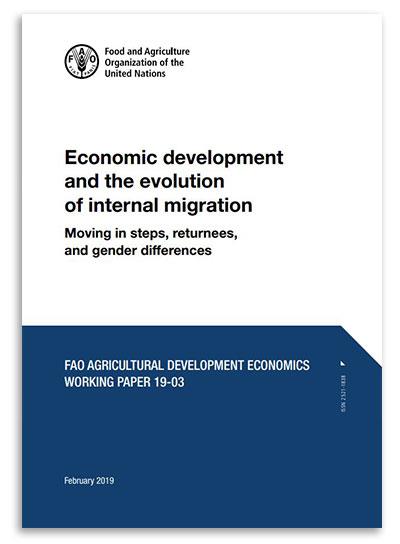
Economic development and the evolution of internal migration. Moving in steps, returnees, and gender differences
18/02/2019
This paper sheds new light on internal migration processes by estimating migration flows for 31 countries, focusing on step migration and on return migration back to rural areas from urban areas. Among other things, this analysis confirms anecdotal evidence that migrants move in several steps and that internal migration patterns vary considerably according to gender. 50 pp.

Fostering the uptake of labour-saving technologies
15/02/2019
This brief introduces key steps, for policy makers and project implementation partners, to address the labour constraints of smallholders through the introduction of technologies that save labour and are women-friendly. The brief also identifies four factors of constraint in the environment that often hinder the uptake of technologies. It presents some FAO examples and illustrates strategies and actions that can be implemented to overcome them. 8 pp.

Paving the way to build the resilience of men and women. How to conduct a gender analysis of resilience
13/02/2019
This paper highlights the need to look further at resilience from a gender perspective and approaches for analysis, given the evolving survey data at the household and individual levels. 45 pp.