


Publications

How to integrate gender issues in climate-smart agriculture projects (Training Module)
23/04/2017
This training module explains gender roles in CSA and their critical impact on project outcomes and sustainability, providing instruction on different methods and tools to identify, formulate, implement, monitor and evaluate gender-responsive actions and practices in CSA development projects. 72 pp.
Joint call for action: Promoting socially inclusive rural development in Europe and Central Asia (Regional Conference, Vilnius, Lithuania)
10/04/2017
As the main outcome of the high-level regional conference Promoting socially inclusive rural development in Europe and Central Asia: Action for the 2030 Agenda, this “joint call for action” covers the main recommendations of the conference, and reinforces a clear pathway for FAO, governments, civil society and the private sector to work together for the achievement of inclusive agriculture, rural development and food security in the framework of the 2030 Agenda. 4 pp.
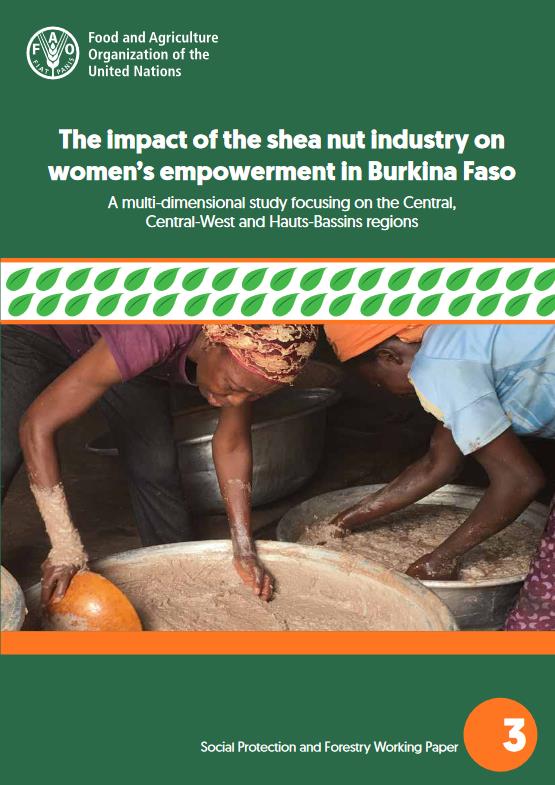
Impact of the shea nut industry on women's empowerment in Burkina Faso
06/04/2017
This study report, developed in collaboration with the Bright Futures of Burkina Faso, is based on the case study in Burkina Faso. It, through a survey of 183 women and 6 men including 36 leaders of shea groups, provides quantitative analysis on the economic resilience derived from shea nuts in terms of income, assets and savings; on the social indicators of wellbeing, education, health and living standards; and on the political implications 60 pp.

Improving Gender Equality in Territorial Issues (IGETI): Territory as an entry to gender equality
04/04/2017
The IGETI approach and guidelines were developed to better address gender inequalities in territorial development. The flyer introduces the concept of territory, explains the relevance of addressing gender equality and presents the IGETI approach and four phases to improve gender equality in territorial issues. 2 pp.

Gender, Food Security and Nutrition in Protracted Crises: Women and girls as agents of resilience
30/03/2017
This guidance note explores gender equality and women’s empowerment as a crucial aspect of FAO's work on food security and nutrition in protracted crises, and discusses practical measures in this regard, such as livelihood support for women and girls, reducing women’s workloads, ensuring protection from gender-based violence and equitable access to resources and services, and, more broadly, transforming gender relations. 28 pp.

Research on rural women’s economic empowerment and social protection (Quantitative report on Rwanda Vision 2020 Umurenge Public Works)
17/03/2017
This research focuses on the public works component of Rwanda’s government programme for poverty reduction and social protection. The research was based on a mixed method approach comprised of in-depth qualitative methods and quantitative surveys conducted in Rwanda in 2014. 58 pages

Armenia: Gender, agriculture and rural development (Country Gender Assessment Series)
06/03/2017
The Country Gender Assessment for Armenia aims to enable better informed, targeted and gender sensitive actions in agriculture and rural development. It discusses some of the major gender inequalities that need to be considered by policy makers and project managers according to available data, and identifies further research needs. 56 pp.

Towards gender-equitable small-scale fisheries
01/03/2017
This document provides a summary of the presentations, discussions, conclusions and recommendations of the “Expert workshop on gender-equitable small-scale fisheries in the context of the implementation of the SSF Guidelines” held in Rome, Italy, on 28–30 November 2016. 80 pp.