


Publications

Qualitative research on women's economic empowerment and social protection: a research guide
13/06/2016
This guide will be used for conducting qualitative research through FAO’s Social Protection and Rural Women’s Economic Empowerment research programme. It describes in detail the sequencing, timing and methodology of the research process, including training, fieldwork preparation and roadmap, key hypotheses, guiding questions and research tools. The guide will also serve as a basis for future FAO research on women’s empowerment and agriculture. 53 pp.
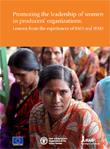
Promoting the Leadership of Women in Producers’ Organizations
06/06/2016
This paper explores aspects of promoting rural women’s leadership in producers’ organizations (POs). Women’s leadership, especially in POs, is essential for increasing the production of smallholder agriculture, as women make massive contributions to the sector. 72 pp.

GENDER NEWS
01/06/2016
The regional gender newsletter serves as a means to share relevant information and lessons amongst Country Offices in the region as well as an advocacy tool. It contains 'stories' from projects in the region as well as more general information related to gender equality. 8 pp.

Regional gender equality strategy for Europe and Central Asia 2016–2017
16/05/2016
The Regional gender strategy represents the common vision of the FAO, including the Regional Off ice for Europe and Central Asia, the Sub-regional Off ice for Central Asia (SEC) and the country off ices, and specifies what FAO intends to achieve in the region over the next two years with respect to its gender programming, and how it will accomplish it. The strategy defines regional priorities and needs, alongside time-bound outcomes, outputs and activities. 16 pp.

Dimitra Newsletter 28
21/04/2016
The newsletter outlines the Dimitra project’s most recent activities and achievements, especially the development and growing impact of the listeners’ clubs. In this issue, we talk about the United Nations Sustainable Development Summit 2015 and COP21 on development and climate change, while giving the floor to various development actors on the theme of gender in resilience and climate change. 24 pp.

Minimum Dietary Diversity for Women: A guide to measurement
11/04/2016
This publication contributes to promoting high standards for nutrition monitoring at country, regional and global levels both for global initiatives such as the Sustainable Development Goals (SDG) and for follow-up activities related to the 2nd International Conference on Nutrition (ICN2), whereby countries are making commitments to take action on nutrition and monitor results. 82 pp.

Gender Integration into Climate-Smart Agriculture (CSA)
08/04/2016
This note provides insight on the data and tools necessary in the analysis of the effects of climate-smart agriculture (CSA) on food security, focusing on a gender perspective. It serves as a guide for those who would like to engage in the study of CSA and gender, and indicates the main challenges and tools identifiable for this type of study. 20 pp.

Gender and Land Statistics
21/03/2016
Land statistics disaggregated by sex are essential to monitor progress towards a more secure and gender-equitable land tenure system and to highlight the disparities in land rights between women and men, providing a sense of women’s economic empowerment in agriculture. This paper provides an overview of five indicators of the Gender Land and Rights Database (GLRD), the dimensions they capture, and how each is calculated. 4 pp.