


FAO at 75
28/10/2020
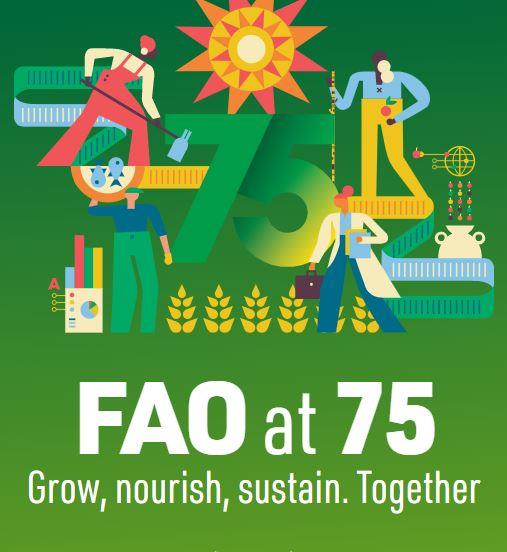
Seventy-five years down the line, FAO’s name, ambition, and spirit remain: everything else has changed, and will change further. Born in 1945 amid the idealism of post-war reconstruction, the Food and Agriculture Organization of the United Nations sets out to increase farm output around the world and make famines a thing...

World Food and Agriculture - Statistical Yearbook 2020
20/10/2020
This publication offers a synthesis of the major factors at play in the global food and agricultural landscape. Statistics are presented in four thematic chapters, covering the economic importance of agricultural activities, inputs, outputs and factors of production, their implications for food security and nutrition and their impacts on the...
World Food Day 2020
16/10/2020
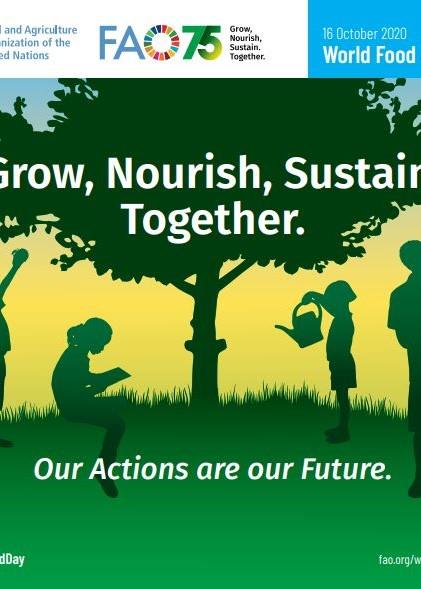
In the 75 years since the founding of FAO, the world has made great progress in the fight against poverty, hunger, and malnutrition. Agricultural productivity and food systems have come a long way. Still, too many people remain vulnerable. More than 2 billion people do not have regular access to...

Investment costs and policy action opportunities for reaching a world without hunger (SDG 2)
12/10/2020
This study reviews the food security situation and change therein in light of recent developments, including COVID-19. It also analyses to which extent G7 countries responded to the challenge and their commitment in terms of development assistance and outlines promising investment opportunities to meet the 2030 targets.
Ending Hunger by 2030 – policy actions and costs
12/10/2020
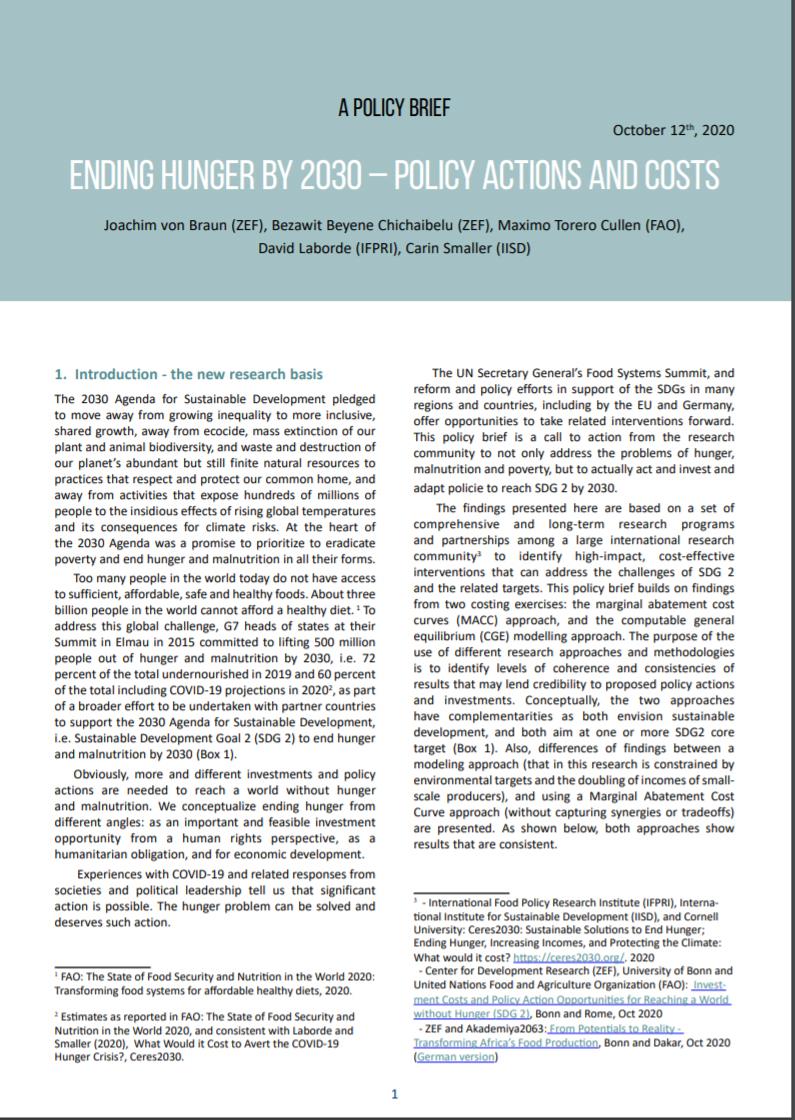
This policy brief builds on findings from two costing exercises: the marginal abatement cost curves (MACC) approach, and the computable general equilibrium (CGE) modelling approach. The purpose of the use of different research approaches and methodologies is to identify levels of coherence and consistencies of results that may lend credibility...

Global Report on Food Crises 2020 September update: in times of COVID-19
09/10/2020
For the last four years, the Global Report on Food Crises (GRFC) has provided an annual, consensus-based overview of the severity, magnitude and drivers of the world’s food crises. The GRFC 2020 reported the highest global number of acutely food-insecure people on record. This GRFC 2020 September update in times of COVID‑19 provides...
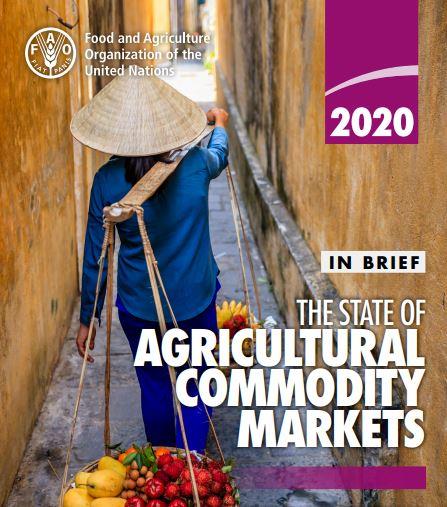
The State of Agricultural Commodity Markets 2020
23/09/2020
This edition of The State of Agricultural Commodity Markets (SOCO) focuses on how markets can bring us closer to achieving the 2030 Agenda for Sustainable Development. SOCO 2020 offers a detailed analysis of the major global trends in agri-food markets and trade to identify how to reap economic, environmental and...
Resources, Partnerships – Impact 2020
28/07/2020
The report elucidates who FAO is, what it has done, and how it has worked in collaboration with multiple stakeholders in 2019. Also, it highlights the way FAO has been adapting to changes in the development aid landscape, specifically by leveraging different kinds of funds and seeking innovative partnerships, in order...

FAO-WFP early warning analysis of acute food insecurity hotspots (2020)
23/07/2020
This joint FAO-WFP analysis highlights countries that are at risk of significant food security deterioration, and in particular acute hunger and associated malnutrition. The analysis takes into account all major drivers of food insecurity, with a particular focus on the secondary impacts of the COVID-19 pandemic. It provides a forward-looking...

The State of Food Security and Nutrition in the World 2020
13/07/2020
Five years into the 2030 Agenda, it is time to assess progress and to question whether continuing efforts implemented thus far will allow countries to reach SDG 2 targets. For this reason, this year’s report complements the usual assessment of the state of food security and nutrition in the world...
The Impact of COVID-19 on Food Security and Nutrition
09/06/2020
The COVID-19 pandemic is a health and human crisis threatening the food security and nutrition of millions of people around the world. Hundreds of millions of people were already suffering from hunger and malnutrition before the virus hit and, unless immediate action is taken, we could see a global food emergency. In the longer term, the...
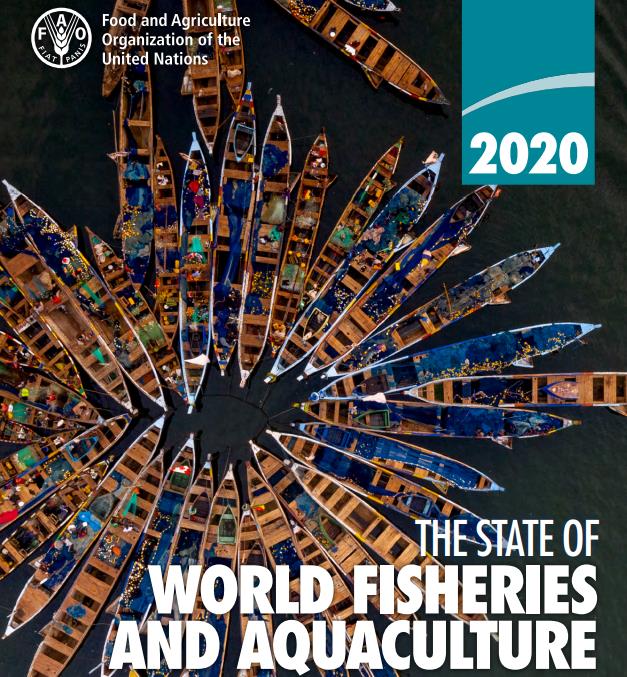
The State of World Fisheries and Aquaculture 2020
08/06/2020
The 2020 edition of The State of World Fisheries and Aquaculture has a particular focus on sustainability. This reflects a number of specific considerations. First, 2020 marks the twenty-fifth anniversary of the Code of Conduct for Responsible Fisheries (the Code). Second, several Sustainable Development Goal indicators mature in 2020. Third,...
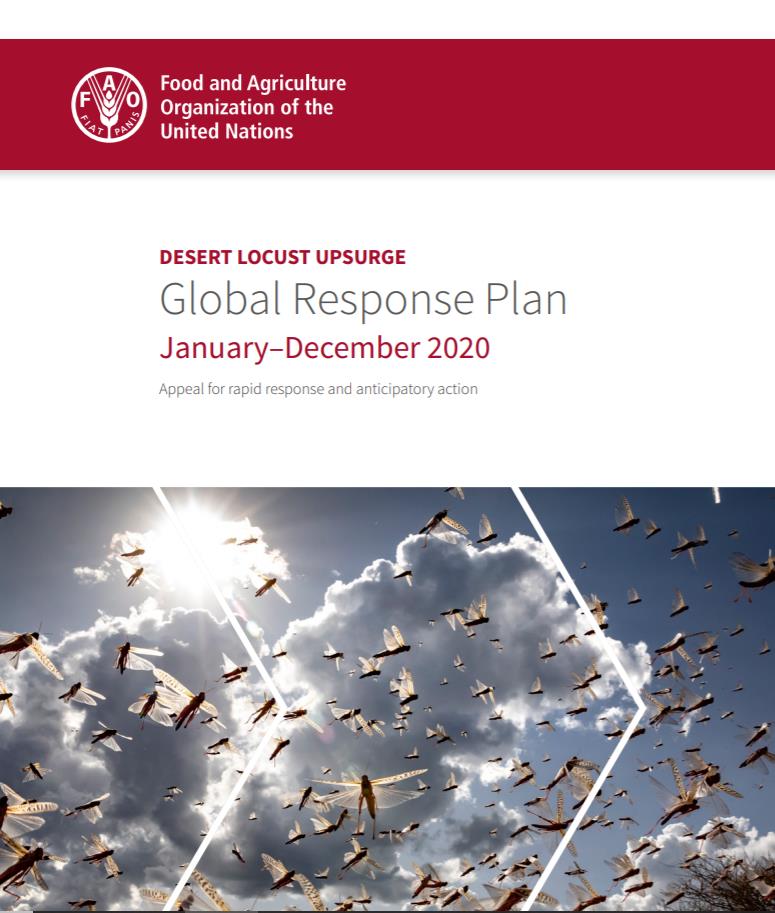
Desert Locust Upsurge Global Response Plan
22/05/2020
A massive Desert Locust upsurge is underway in the Greater Horn of Africa, the Arabian Peninsula and Southwest Asia, with the risk of it spreading to the Sahel region if it is not halted by July. Anticipating a potential upsurge in West Africa, mobilizing for a scale up activities in...
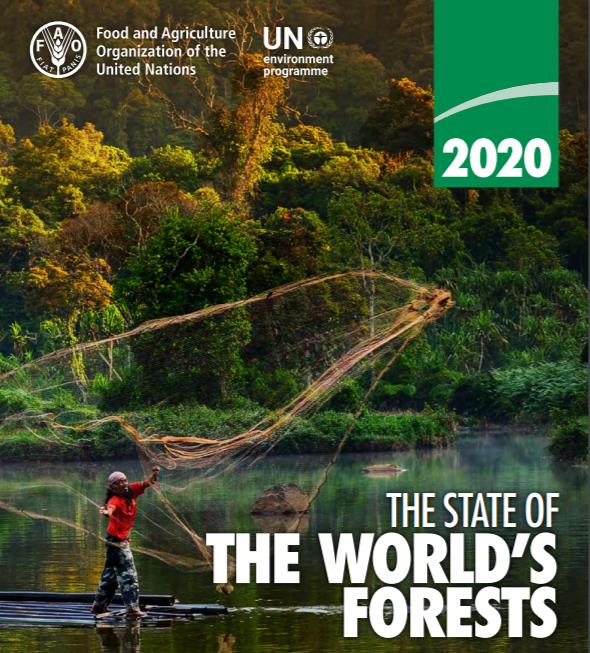
The State of the World's Forests 2020
22/05/2020
The 2020 edition of The State of the World's Forests examines the contributions of forests, and of the people who use and manage them, to the conservation and sustainable use of biodiversity. It assesses progress to date in meeting global targets and goals relating to forest biodiversity and describes the effectiveness of policies, actions...
Comparing crises: Great Lockdown versus Great Recession
08/05/2020
A comparison of the Great Lockdown of 2020 underway with the Great Recession of 2009, reveals some regularities, yet many differences. Notably, the shock associated with the Great Recession arose out of economy-wide stress, particularly high-income countries, while in direct contrast, the Great Lockdown was borne outside of the global...
Previous Newsletters
2026: January, February, March, April, May, June, July, September,
2025: January, February, March, April, May, June, July, September, October, November , December
2024: January, February, March, April, May, June, July, August, September, October, November, December
2023: January, February, March, April, May, June, July, August, September, October, November, December
2022: January, February, March, April, May, June, July, August, September, October, November, December
2021: January, February, March, April, May, June, July, August, September, October, November, December
2020: January, February, March, April, May, June, July, September, October, November, December