


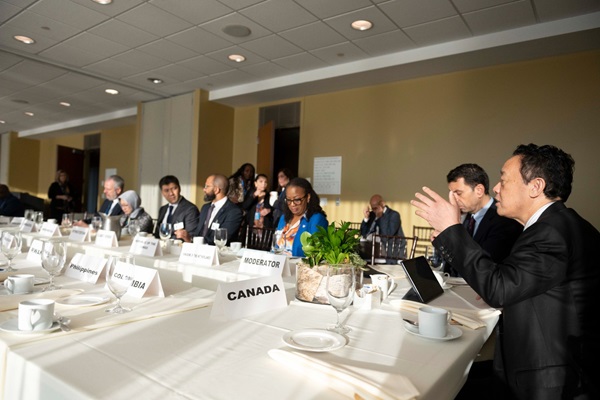
SDG Summit: FAO Ministerial Dialogue underscores the links between biodiversity, climate and food security
19/09/2023
On day two of the UN SDG Summit and just ahead of the General Debate, the Director General of the Food and Agriculture Organization of the United Nations (FAO), QU Dongyu, held a Ministerial dialogue at UN Headquarters on the opportunities of scaling up action and investment for agrifood systems transformation as a solution to the biodiversity and climate crises.
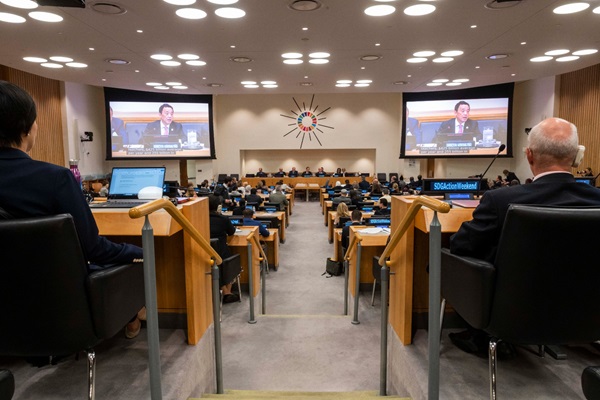
SDG Action Weekend: FAO touts High Impact Initiatives to transform agrifood systems and boost the 2030 Agenda
17/09/2023
Ahead of the 2023 SDG Summit, the Food and Agriculture Organization of the United Nations (FAO) and its partners presented on Sunday the High Impact Initiative on Food Systems Transformation aimed at mobilizing commitments to ensure food security and healthy diets for all.

To transform agrifood systems, we must implement climate change and biodiversity agendas in tandem
09/03/2023
The rethinking of food and agriculture and the necessary sector transformations we need moving forward must take into consideration the implementation of the closely interlinked climate change and biodiversity outcomes from COP27 and COP15, respectively.

Africa's major crop: How Climate-Smart Agriculture is enabling farmers to reap record-high cassava yields using nuclear science and technology
24/07/2023
One of the most important food security crops in Africa is cassava, a root vegetable eaten by around half a billion people every day. Africa produces nearly 200 million tonnes of cassava every year, around 60 per cent of the world’s total production. However, due to climate change, water scarcity...

Cultivating adaptation in Senegal: a SAGA for a better future
30/08/2023
On 25 January 2023, I visited Pandiénou, a village in the Thiès region of western Senegal, together with Québec's Minister of International Relations and La Francophonie, Martine Biron. During this visit to a Farmer Field School (FFS), we met local women and youth who face the impacts of climate change on a daily basis. I listened to their stories and learned about the benefits of hands-on group learning. Pandiénou is more than a village; it encapsulates both the challenges facing smallholder farmers across Senegal and the solutions to tackle the climate crisis that exists within communities. I witnessed firsthand how the FAO Strengthening Agricultural Adaptation (SAGA) project fosters community engagement, resilient agriculture, and sustainable development.
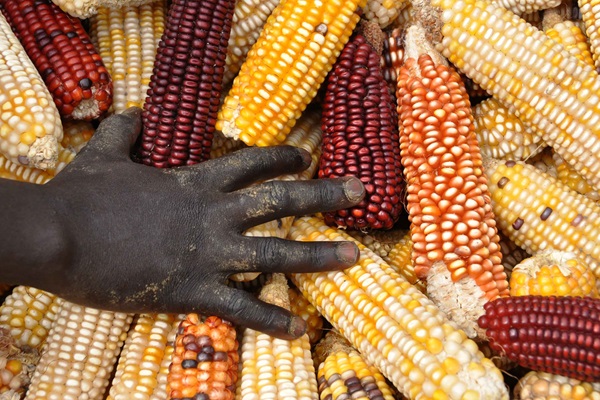
Efforts to safeguard biodiversity receive welcome boost
28/08/2023
Vancouver - The Food and Agriculture Organization of the United Nations (FAO) has welcomed the launch of the Global Biodiversity Framework Fund during the Seventh Global Environmental Facility (GEF) Assembly in Vancouver, Canada.

Artificial glacier helps mountain village in Kyrgyzstan meet water needs
21/08/2023
Following the Kyrgyz tradition, Manzura Orolbaeva welcomes guests with homemade bread and a saucer of melted butter. The bread is made from grain grown on their farm and the butter from the livestock they keep.

Finding greener, more climate-resilient ways of producing our food
02/11/2021
Agriculture offers innovative solutions to the climate crisis… for the globe and its own survival!

Better livestock production improves family well-being and acts against climate change in Uruguay
16/08/2022
How climate-smart practices are providing better incomes and a more resilient environment

A wall that restores land and empowers communities in Niger
07/11/2022
Great Green Wall activities revive ecosystems around the urban commune of Kollo

A quick win in battle against climate crisis
14/11/2022
FAO technical support for investments helps improve livelihoods and nutrition while curbing livestock greenhouse gas emissions

Changing the urban landscape. Greening city living.
31/10/2022
FAO’s Green Cities Initiative is transforming urban and peri-urban areas in Africa and worldwide

One drop at a time: Silotte Mervil – an innovative Haitian farmer
09/08/2023
Silotte Mervil, a fifty-four-year-old smallholder farmer and mother of five, is determined to make a difference on her land in Maïssade, a commune in central Haiti. She produces vegetables to feed her family and generate income, refusing to feel helpless. Her resilience and success have been boosted by her active participation in the Strengthening Agricultural Adaptation (SAGA) project, implemented by FAO. This project, financed by the Government of Quebec, aims to strengthen the resilience of the Haitian agricultural sector to climate change and to increase capacity building and adaptation planning for better food security and nutrition.

Indigenous youth: future guardians of the Earth’s Biodiversity
08/08/2023
What is at stake if Indigenous Peoples’ knowledge is not passed down to today’s youth? Quite simply, the planet as we know it! The reality is that Indigenous Peoples are guardians to almost 80 percent of the world’s remaining biodiversity. Representing six percent of the global population, Indigenous Peoples’ territories cover 28 percent of the Earth’s surface, and 11 percent of the world’s forests lie within these territories.

FAO at COP28
04/08/2023
The 2023 United Nations Climate Change Conference (COP28) hosted by the United Arab Emirates in Dubai will take place between 30 November and 12 December. The Conference is set to be a landmark event in the global effort to combat climate change and ensure food security for present and future generations.

New FAO publication enables measurement of progress on agricultural adaptation and the Global Goal for Adaptation
01/08/2023
Recognizing that adaptation is a globally significant issue, the Global Goal on Adaptation (GGA) was established under the Paris Agreement to boost work on adaptation with the aim of building adaptive capacity, strengthening resilience, and reducing vulnerability to climate change. However, the path to assessing the GGA has been slow and complex due to methodological challenges in defining targets, measuring adaptation and the lack of a universal metric.

Reviving Azerbaijan’s cotton industry with nuclear techniques and climate-smart agriculture
31/07/2023
The first traces of cotton growing in Azerbaijan date back thousands of years. During the Soviet era, it was referred to as "white gold," accounting for approximately 25 percent of agricultural revenue. However, the transition to a free market economy, coupled with the rapid growth of alternative industries in the 1990s, contributed to cotton losing its key role. Production fell to a record low of 31 000 tonnes in 2009, compared to more than 830 000 tonnes in the 1980s.

Take part in the innovation factory start-up pitching challenge
01/08/2023
Could Artificial Intelligence (AI) be the solution to the world’s climate crisis? AI is a tool that is already providing insights into where and how climate change is affecting our agriculture and food systems.

UNFSS+2: FAO highlights the power of transforming agrifood systems for climate action
24/07/2023
Climate Action took center stage during the first day of the UN Food Systems Summit+2 Stocktaking Moment (UNFSS+2) during an Italy-led high-level event dedicated to exploring solutions to build climate-resilient agrifood systems and reduce their carbon footprint to meet the growing global demand for food, while protecting the environment.

UN Food Systems Summit +2 Stocktaking Moment
21/07/2023
Next week from 24 – 26 July 2023, Rome takes center stage hosting the UN Food Systems Summit +2 Stocktaking Moment. The event is hosted by Italy in collaboration with the Rome-based UN Agencies (FAO, IFAD, WFP), the UN Food Systems Coordination Hub and the wider UN system and will take place at the Headquarters of the Food and Agriculture Organization of the United Nations.