


Areas of work

Knowledge Platform
Agroecology
Agroecology is a holistic and integrated approach that simultaneously applies ecological and social concepts and principles to the design and management of sustainable agriculture and food systems. It seeks to optimize the interactions between plants, animals, humans and the environment while also addressing the need for socially equitable food systems within which people can exercise choice over what they eat and how and where it is produced.

Global Programme
Global Programme on Sustainable Dryland Agriculture
Drylands are home to an estimated 2 billion people, about 90 percent of them in developing countries. Drylands are also home to a great variety of indigenous livestock breeds and plant species that are essential for food security and livelihoods. Drylands represent 43.2 percent of total global area in 2020, and are predicted to be 44.2 percent in 2050.

Knowledge Platform
Conservation Agriculture
Conservation Agriculture is a farming system that promotes minimum soil disturbance (i.e. no tillage), maintenance of a permanent soil cover, and diversification of plant species. It enhances biodiversity and natural biological processes above and below the ground surface, which contribute to increased water and nutrient use efficiency and to improved and sustained crop production.

Thematic highlight
Gender equality in plant production and protection

Knowledge Platform
Desert Locust Management
FAO closely monitors the global desert locust situation 24/7, providing forecasts, early warnings, and alerts regarding the timing, scale, and location of invasions and breeding through its global Desert Locust Information Service (DLIS). All locust-affected countries transmit locust data to FAO, which in turn analyzes this information alongside weather and habitat data, as well as satellite imagery, to assess the current locust situation. FAO then provides forecasts up to six weeks in advance and issues warnings on an ad hoc basis.

Knowledge Platform
Transboundary Plant Pests and Diseases
FAO continuously monitors and provides early warnings on transboundary plant pests and diseases (TPPDs) to help manage and prevent their spread, fostering cooperation between countries. Member states receive advice on the most effective strategies to manage TPPDs and mitigate their spread. FAO advocates for sustainable, ecological approaches to address the potential impact of TPPDs, through the promotion of innovative, environmentally friendly and control measures.

Knowledge Platform
Seeds
Seeds are the primary basis for human sustenance. They are the repository of the genetic potential of crop species and their varieties resulting from the continuous improvement and selection over time. Crop improvement and the delivery of high quality seeds and planting materials of selected varieties to growers is necessary for ensuring improved crop production and meeting growing environmental challenges. Food security therefore is dependent on the seed security of farming communities.

World Bee Day
20 May

Knowledge Platform
Sustainable Agricultural Mechanization
Mechanization covers all levels of farming and processing technologies, from simple and basic hand tools to more sophisticated and motorized equipment. It eases and reduces hard labour, relieves labour shortages, improves productivity and timeliness of agricultural operations, improves the efficient use of resources, enhances market access and contributes to mitigating climate related hazards.

Knowledge Platform
Pest and Pesticide Management
Pesticides are any substance or mixture of substances made up of chemical or biological ingredients and intended to repel, destroy or control pests, or to regulate plant growth. Pests are a major cause of crop yield losses. FAO estimates that plant pests and diseases account for the reduction of between 20 and 40 percent of global crop yields per year. Crop losses contribute to food insecurity, which continues to grow with increasing population numbers in the face of climate challenges.

Knowledge Platform
Urban and Peri-Urban Agriculture
Urban and peri-urban agriculture (UPA) can be defined as practices that yield food and other outputs through agricultural production and related processes, taking place on land and other spaces within cities and surrounding regions. It involves urban and peri-urban actors, communities, methods, places, policies, institutions, systems, ecologies and economies, largely using and regenerating local resources to meet changing needs of local populations while serving multiple goals and functions.

International Day of Potato
30 May
Global Programme
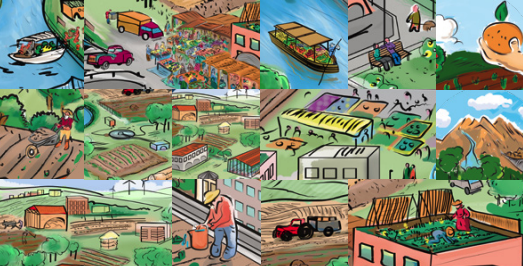
City Region Food Systems Programme
Adopting a City Region Food Systems (CRFS) approach offers concrete policy and programme opportunities where urban developmental issues can be addressed and rural and urban communities can be directly linked. Improved city region food systems improve economic, social and environmental conditions in both urban and nearby rural areas.

Knowledge Platform
Farmer Field Schools
A Farmer Field School brings together a group of farmers, livestock herders or fisherfolk, to learn on how to shift towards more sustainable production practices, by better understanding complex agro-ecosystems and by enhancing ecosystem services. A FFS group meets regularly during a production cycle, setting up experimentation and engaging in hands-on learning to improve skills and knowledge that will help adapt practices to their specific context.
Latest news from Plant Production and Protection

News
Guinea-Bissau strengthens its cashew value chain under OCOP initiative
16/03/2026
AO is strengthening Guinea-Bissau’s cashew value chain under the OCOP initiative by improving farming practices, diversifying crops and supporting local...

Latest news
Students explore chemical safety and global cooperation at FAO
27/02/2026
FAO headquarters welcomed 32 students from the undergraduate programme in Global Governance at the University of Rome Tor Vergata for a half-day learning...

News
Water scarcity and the pistachio predicament
23/02/2026
This story explores how farmers like Maryam, tends hundreds of pistachio trees on a single hectare of arid land where water scarcity threatens...

News
Albania and FAO expand partnership to protect Albania's chestnuts
17/02/2026
Albania has taken a major step to protect its iconic chestnut forests, as the Ministry of Agriculture and Rural Development (MARD) strengthened national...

News
Africa’s crop diversity under threat, action needed to protect food security and nutrition
12/02/2026
Africa is losing the plant diversity that underpins food security and nutrition, climate resilience and livelihoods across the continent. This is according...

News
FAO and Spain underscore the value of pulses at the World Pulses Day celebration
10/02/2026
The World Pulses Day 2026 celebration took place in Valladolid, Spain, bringing together government representatives, chefs, experts, and stakeholders...

Latest news
World Pulses Day – The exhibition
04/02/2026
On the occasion of the World Pulses Day 2026, the FAO Museum...

News
Africa launches push to close agricultural mechanization gap as landmark conference begins
03/02/2026
Africa’s push to accelerate sustainable agricultural mechanization gained fresh momentum today as the Prime Minister of the United Republic of Tanzania,...

News
Mechanizing Africa’s farms won’t work unless we do it differently
03/02/2026
Africa’s mechanization efforts have too often relied on imported models that fail local farmers. A new approach, championed through ACSAM, is shifting...

News
Machine power that empowers
03/02/2026
Today, a new wave of innovation is redefining what mechanization means for agriculture, and agriculture in Africa in particular. With a focus...

Latest news
FAO announces the theme for World Pulses Day 2026
30/01/2026
The theme “Pulses of the world: from modesty to excellence” was selected to highlight the required transformation – from humble origins to global...

Latest news
Best practices and innovations in fruits and vegetables value chains: Call for nominations
28/01/2026
FAO is inviting submissions of replicable and adaptable case studies that present best practices and innovations with demonstrated impact or strong...

News
Spain to host World Pulses Day celebration in 2026
23/01/2026
FAO and the Kingdom of Spain are collaborating in the organization of this year’s observance, which is scheduled for 10 February 2026 at the Miguel...

News
How to Feed Ten Billion People
19/01/2026
With the world’s population expected to reach ten billion by mid-century, agriculture must produce more with less – every season, everywhere. The knowledge...

News
FAO launches new COAG brochure to commemorate FAO’s 80th anniversary
29/12/2025
The Food and Agriculture Organization of the United Nations (FAO) has released a new brochure on the Committee on Agriculture (COAG) to commemorate...

News
“From Seeds to Foods”: a visual journey now captured in a report about the exhibition
22/12/2025
What does it take to feed the world – today and tomorrow? The answer came to life in “From Seeds to Foods,” FAO’s first-ever global...

News
Young professionals carry cardamom success from East to West Nepal
22/12/2025
A week-long learning mission under FAO’s One Country One Priority Product (OCOP) initiative brought together the government agricultural officers and...

Latest news
Desert locust outbreak persists in Northwestern Africa: Control measures must increase to avoid further spread in 2026
22/12/2025
FAO warns that a serious desert locust outbreak continues in Northwestern Africa, with the situation remaining critical in Mauritania. A third generation...

News
The Regional Launch for Latin America and the Caribbean of The Third Report on the State of the World’s Plant Genetic Resources for Food and Agriculture
24/11/2025
This high-level, policy-focused dialogue convened ambassadors, policymakers, partners, and experts to discuss the respective priorities for conserving...

News
Countries of Europe and Central Asia continue to benefit from OCOP initiative
06/12/2025
FAO and its regional partners strengthened strategic coordination, partnerships, and implementation planning for the One Country One Priority Product...