


Areas of work

Knowledge Platform
Agroecology
Agroecology is a holistic and integrated approach that simultaneously applies ecological and social concepts and principles to the design and management of sustainable agriculture and food systems. It seeks to optimize the interactions between plants, animals, humans and the environment while also addressing the need for socially equitable food systems within which people can exercise choice over what they eat and how and where it is produced.

Global Programme
Global Programme on Sustainable Dryland Agriculture
Drylands are home to an estimated 2 billion people, about 90 percent of them in developing countries. Drylands are also home to a great variety of indigenous livestock breeds and plant species that are essential for food security and livelihoods. Drylands represent 43.2 percent of total global area in 2020, and are predicted to be 44.2 percent in 2050.

Knowledge Platform
Conservation Agriculture
Conservation Agriculture is a farming system that promotes minimum soil disturbance (i.e. no tillage), maintenance of a permanent soil cover, and diversification of plant species. It enhances biodiversity and natural biological processes above and below the ground surface, which contribute to increased water and nutrient use efficiency and to improved and sustained crop production.

Thematic highlight
Gender equality in plant production and protection

Knowledge Platform
Desert Locust Management
FAO closely monitors the global desert locust situation 24/7, providing forecasts, early warnings, and alerts regarding the timing, scale, and location of invasions and breeding through its global Desert Locust Information Service (DLIS). All locust-affected countries transmit locust data to FAO, which in turn analyzes this information alongside weather and habitat data, as well as satellite imagery, to assess the current locust situation. FAO then provides forecasts up to six weeks in advance and issues warnings on an ad hoc basis.

Knowledge Platform
Transboundary Plant Pests and Diseases
FAO continuously monitors and provides early warnings on transboundary plant pests and diseases (TPPDs) to help manage and prevent their spread, fostering cooperation between countries. Member states receive advice on the most effective strategies to manage TPPDs and mitigate their spread. FAO advocates for sustainable, ecological approaches to address the potential impact of TPPDs, through the promotion of innovative, environmentally friendly and control measures.

Knowledge Platform
Seeds
Seeds are the primary basis for human sustenance. They are the repository of the genetic potential of crop species and their varieties resulting from the continuous improvement and selection over time. Crop improvement and the delivery of high quality seeds and planting materials of selected varieties to growers is necessary for ensuring improved crop production and meeting growing environmental challenges. Food security therefore is dependent on the seed security of farming communities.

World Bee Day
20 May

Knowledge Platform
Sustainable Agricultural Mechanization
Mechanization covers all levels of farming and processing technologies, from simple and basic hand tools to more sophisticated and motorized equipment. It eases and reduces hard labour, relieves labour shortages, improves productivity and timeliness of agricultural operations, improves the efficient use of resources, enhances market access and contributes to mitigating climate related hazards.

Knowledge Platform
Pest and Pesticide Management
Pesticides are any substance or mixture of substances made up of chemical or biological ingredients and intended to repel, destroy or control pests, or to regulate plant growth. Pests are a major cause of crop yield losses. FAO estimates that plant pests and diseases account for the reduction of between 20 and 40 percent of global crop yields per year. Crop losses contribute to food insecurity, which continues to grow with increasing population numbers in the face of climate challenges.

Knowledge Platform
Urban and Peri-Urban Agriculture
Urban and peri-urban agriculture (UPA) can be defined as practices that yield food and other outputs through agricultural production and related processes, taking place on land and other spaces within cities and surrounding regions. It involves urban and peri-urban actors, communities, methods, places, policies, institutions, systems, ecologies and economies, largely using and regenerating local resources to meet changing needs of local populations while serving multiple goals and functions.

International Day of Potato
30 May
Global Programme
City Region Food Systems Programme
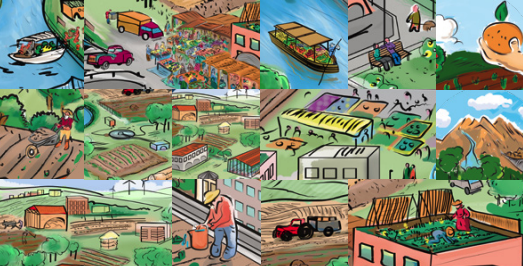
Adopting a City Region Food Systems (CRFS) approach offers concrete policy and programme opportunities where urban developmental issues can be addressed and rural and urban communities can be directly linked. Improved city region food systems improve economic, social and environmental conditions in both urban and nearby rural areas.
Latest news from Plant Production and Protection

Latest news
Upcoming global exhibition to feature 29 talks representing over 22 countries
06/10/2026
You are invited to meet farmers, scientists, entrepreneurs, community representatives and food specialists working to make our agrifood systems more...

Latest news
Around the globe in one Seeds to Foods journey
01/10/2026

Latest news
Indonesia's coffee heritage: Cultivating coffee, connecting the world
01/10/2026
On the first United Nations International Day of Coffee, FAO and partners highlight the vital contribution of smallholder farmers. As the world's...
82e82c18-7603-4379-a87f-b81f4b689b1d.tmb-th600x400.jpg?sfvrsn=5ca68339_1 "img_0564-(1)82e82c18-7603-4379-a87f-b81f4b689b1d")
Latest news
Farmers rethink how they plant wheat
30/09/2026
For years, wheat farmers in Afghanistan’s central highlands have relied on methods passed down through generations. In Daikundi Province, many traditionally...

Latest news
Experts call for stronger action on sustainable plant health
29/09/2026
Every healthy harvest begins long before the first grain is collected. It starts with healthy soil, resilient ecosystems and smart decisions in the...

Latest news
Strengthening capacities for chemicals and pesticides management in Asia
23/09/2026
Thirty experts from 16 country across the Asia Prior...

Latest news
Plant health taking the stage at One Health conference
22/09/2026
Healthy plants are essential to healthy people, animals and ecosystems. Bringing plant health more firmly into the One...

news
Connecting standards for a stronger One Health Approach
21/09/2026
Almost two thousand years ago, Marcus Aurelius counselled that we should “constantly regard the universe as one living being”. Today, that idea is...

news
Women farmers are pioneering safer agrifood systems
18/09/2026
Women play a crucial role in global agrifood systems, particularly in small-scale farming, yet they are disproportionately exposed to the risks associated...

news
Global experts convene to review chemicals and pesticides for potential action under the Rotterdam Convention
15/09/2026
The twenty-second meeting of the Chemical Review Committee (CRC.22), a subsidiary body of the Rotterdam Convention, formally opened this morning...
.tmb-th600x400.jpg?sfvrsn=674f170a_2 "S2F_Illustration_Facebook Banner_EN (1)")
Latest news
From Seeds to Foods: Less than a month to go
11/09/2026
An interview with Yurdi Yasmi, Director of FAO Plant Production and Protection, ahead of the FAO...
.tmb-th600x400.jpg?sfvrsn=83b4182e_1 "UF1B4PK IMG_6127 (1)")
FAO supports Iran on updating the Global Plan of Action for Plant Genetic Resources
31/08/2026
FAO held a technical meeting with the National Plant Gene Bank of Iran to support the revision of the Global Plan of Action for Plant Genetic Resources...

Latest news
FAO Director-General: Unlocking horticulture’s potential is key to transforming agrifood systems and delivering healthy diets for all
24/08/2026
Agriculture must move beyond a primary focus on producing sufficient quantities of food and place greater emphasis on providing the diverse and nutritious...

News
Saudi Arabia provides USD 2 million in in-kind assistance to strengthen the capacities of member countries of the Commission for Controlling the Desert Locust in the Central Region
10/08/2026
As part of the close cooperation between the Kingdom of Saudi Arabia and FAO, a record acknowledging receipt of the generous in-kind assistance provided...
-(1).tmb-th600x400.jpg?sfvrsn=a6d39879_4 "OCOP_Global Workshop")
Latest news
China hosts global FAO workshop on value chains of tropical agricultural products
06/08/2026
More than 40 government representatives, technical experts and development partners from tropical countries across Africa, Asia, the Near East, Latin...

Latest news
Andean agriculture benefits from knowledge sharing with FAO
05/08/2026
FAO and the Rotterdam Convention are strengthening cooperation with the Andean Community to support more sustainable and resilient agrifood systems....
.tmb-th600x400.jpg?sfvrsn=8d3025d8_2 "UF1AM1L 12407d-2602 (1)")
Latest news
FAO Global Exhibition: From Seeds to Foods is coming in October 2026
24/07/2026
FAO, in collaboration with the City of Rome, Italy are hosting the second edition FAO Global Exhibition: From Seeds to Foods. The exhibition will be...

Latest news
Advancing plant health in One Health: roles, challenges and prospects
23/07/2026
How can healthier plants contribute to healthier people, animals and ecosystems? This question brought together policymakers, scientists and a wide...

FAO Committee on Agriculture opens with strong call for science, innovation and technical solutions
20/07/2026
The 30th Session of the Committee on Agriculture (COAG 30) opened today at...

Your questions on plant production and protection systems answered
23/07/2026
To strengthen the understanding of four key areas of its work in this domain, FAO has produced leaflets that answer frequently asked questions on:...