


Completed evaluations

Evaluation of the work of the Subregional Office for Mesoamerica 2012-2017
07/10/2019
In 2018, the FAO Office of Evaluation (OED) conducted an evaluation of the work of the Subregional Office for Mesoamerica (SLM) covering the period 2012-2017. SLM offers adequate technical support for the development and increase of FAO operations in Mesoamerica and has generated synergies with other subregional or regional initiatives. With SLM's...

Final Evaluation of the Project “Land Rehabilitation and Rangelands Management in Smallholders Agro-pastoral Production Systems in South Western Angola (RETESA)”
16/09/2019
In Southwest Angola, the impacts of climate change have contributed to a reduction in soil coverage and an increase in soil erosion. To address these challenges, the GEF project "Land Rehabilitation and Rangelands Management in Smallholders Agro-pastoral Production Systems in South Western Angola” supported activities contributing to the strengthening of...

Mid-term evaluation of the FAO-EU FLEGT Programme, phase III
05/09/2019
The FAO-EU FLEGT Programme supports government agencies, non-governmental organizations and private sector associations to work together in support of legal and trade reforms in timber producing countries with the aim of increasing legal trade in timber.

Final evaluation of the project “Integrated management of mangrove and associated wetlands and coastal forest ecosystems in the Republic of the Congo”
07/08/2019
The project "Integrated management of mangroves and associated wetlands and coastal forest ecosystems in the Republic of the Congo" was implemented between July 2013 and December 2017 by the Government of the Republic of the Congo and FAO. The main phase of the final evaluation, which took place between July...

Evaluation of FAO’s contribution to the Democratic Republic of Timor-Leste 2015-2018
07/08/2019
Much of Timor-Leste’s economic infrastructure became severely damaged after decades of conflict. This has negatively impacted many of the country’s essential services such as healthcare, agriculture and education. FAO intervened in support of small-scale family farming with a programme focused on a set of much needed policy formulations and revisions, agriculture data and information generation, climate-resilience farming and ecosystem-based natural resource management.
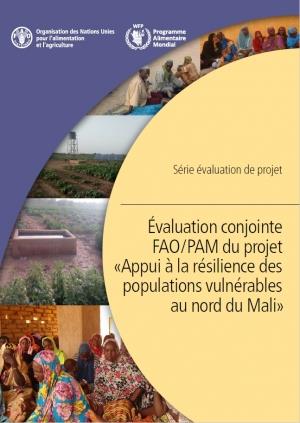
Joint FAO/WFP evaluation of the project "Supporting the resilience of vulnerable populations in northern Mali"
24/07/2019
Between 2015 and 2018, FAO and WFP implemented a joint programme funded by the European Union to build community resilience in northern Mali. A final evaluation was conducted between May and September 2018. (In French)

Final Evaluation of the Project for Building Resilience and Self-reliance of Livestock Keepers by Improving Control of Foot-and-Mouth Disease and other Transboundary Animal Diseases in Afghanistan
17/07/2019
The Project ‘Building resilience and self-reliance of livestock keepers by improving control of FMD and other Transboundary Animal Diseases (TADs)’ aimed at providing assistance at central, province, and community level, in strengthening food security through an improved on-farm livestock healthcare system.

Final evaluation of the project “Climate Change Adaptation to Reduce Land Degradation in Fragile Micro-Watersheds located in the Municipalities of Texistepeque and Candelaria de la Frontera”
17/07/2019
Climate change patterns, extreme weather events, land degradation and soil erosion have had a negative impact on agricultural production and the livelihood assets of poor people in rural areas in El Salvador; moreover, the country’s main water resource, within the Dry Corridor of Central America, has been affected by increase...

Evaluation FAO's programme of work in Mexico 2013-2018
16/07/2019
This evaluation was carried out in order to analyze the contributions made by FAO to the national development objectives of the Government of Mexico in the period 2013-18, based on the prioritized areas in the country programming framework. (Spanish only).

Programme Evaluation Report 2019
12/06/2019
The biennial programme evaluation report provides highlights of the FAO Office of Evaluation’s findings. During the 2017‒2018 biennium, FAO made further efforts to operationalize its strategic planning approach. Consequently, our thematic evaluations focused on FAO’s contributions to its Strategic Objectives.